
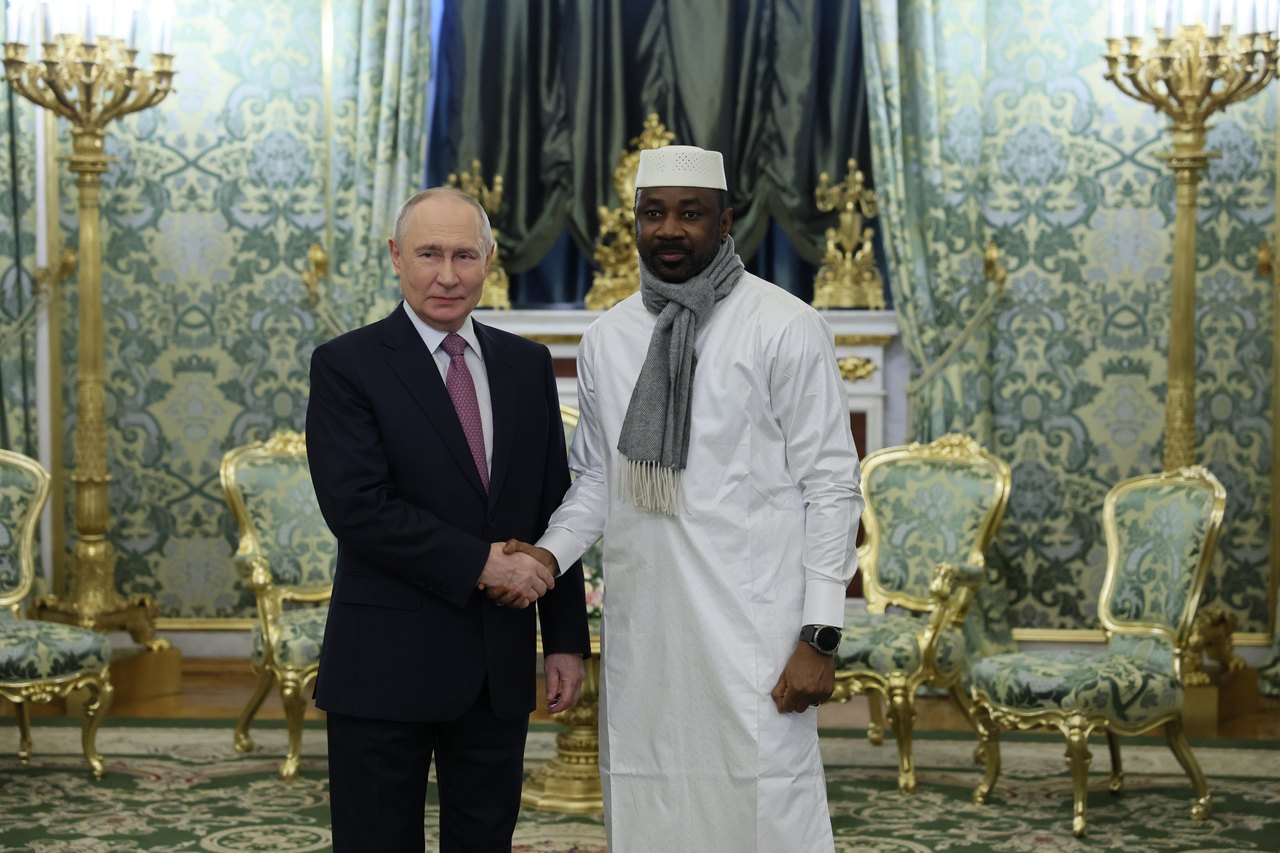
Mali’s transitional president, Assimi Goïta, used a meeting with Vladimir Putin to ask Russia for help that goes beyond the military partnership already in place. He wanted intelligence, equipment to watch Malian territory, and a new opening in cybersecurity. He did not, on the public record, leave with a deal.
The request was made on 30 October 2026 at the Kremlin, on the sidelines of the third Russia–Africa Summit. La Nouvelle Tribune, in a report published on 1 November by Charly Hessoun, attributed the account to a communication from the Malian presidency. Bamako, the paper said, also wanted to open a cybersecurity track, “but no agreement was announced at the end of the meeting.”
The same outline was carried by Bénin Web TV and by subsequent reports that relied on those accounts. The core facts are consistent. Goïta asked for the sharing of Russian intelligence, for surveillance equipment, and for cyber cooperation. Putin received him. Nothing was announced as signed.
Goïta, according to La Nouvelle Tribune, argued that a closer relationship with Moscow had become “imperative” in the face of geopolitical upheaval. In that setting he praised the Russian forces “who are fighting at our side for our territorial integrity.” He said the partnership had allowed Mali to recover its full sovereignty by degrees, and he thanked Moscow for its support to the countries of the Confederation of Sahel States, which brings together Mali, Burkina Faso and Niger.
Putin, the same report said, recalled the entry into force, in May 2026, of a fundamental agreement between the two states, and the 66 years of their diplomatic relations. The two leaders also discussed civil nuclear power, solar energy, electricity grids, technical training and the local processing of mining resources.
The October conversation sits on a longer relationship. In June 2025 Goïta made an official visit to Russia, during which, La Nouvelle Tribune reported, three agreements were signed, including one on security and military cooperation that provided for training, equipment and operational support. Bamako officially recognises the presence of Africa Corps, a structure attached to Russia’s Defence Ministry.
What was new in October was the explicit turn towards intelligence, territorial surveillance and cyber cooperation. Those are tools of internal control as well as of defence against insurgent groups. Mali has been under military rule since the coups of 2020 and 2021, and Goïta’s government has steadily shifted its security partnerships away from France and towards Russia and its Sahel neighbours. Asking Moscow for intelligence and for equipment to monitor the national territory is a logical next request in that alignment. It is also a request that, if granted, would deepen Russia’s role in how Mali sees and polices itself.
No public text of a new intelligence or cyber accord has been produced. The presidency’s communication, as relayed by La Nouvelle Tribune, is an account of what was asked, not of what was agreed. That distinction should be held. African newsrooms that followed the story, including AFREEQUE, repeated the same warning: no agreement was announced.
The wider talks in Moscow were not confined to security. Civil nuclear power, solar energy, the electricity network, the training of technicians and the local processing of minerals were all on the table, according to the same presidential account. Those subjects echo the economic and technical agenda that has accompanied the military relationship since 2025. They also remain, for now, a list of topics rather than a list of signed projects dated to this meeting.
Goïta had arrived in Moscow ahead of the summit, which was held on 28 and 29 October, and he returned to Bamako on 1 November. The 30 October audience was one of a series of bilateral meetings Putin held around the gathering. For Bamako, the message was that the partnership should move out of its familiar military lane and into intelligence, cyber systems and energy. For Moscow, the public remarks reported from the Russian side dwelt on the fundamental agreement already in force and on a broader economic conversation.
The presidency’s decision to put the intelligence and surveillance request into a public communication is itself notable. It tells Malians, and anyone watching the Sahel, that Bamako is no longer treating those subjects as matters to be left unsaid. It does not tell them whether Moscow has agreed to supply the equipment, to share intelligence on a standing basis, or to staff a cyber programme. Until a later announcement, or a later leak that can be independently checked, the only firm additions to the record are the request and the absence of a deal.
Whether the intelligence and surveillance request will become a contract, a secret arrangement or a dead letter is not something the published record can settle. The honest account is narrower, and still significant. On 30 October, in a formal meeting with Putin, Mali’s transitional president asked Russia to share its intelligence, to supply the means to watch Malian territory, and to work with Bamako on cybersecurity. The presidency said so. No deal was announced. The ask is on the record. The answer, if there is one, is not.