
ENTEBBE — 23 November 2026
Somalia and Uganda have called for a stronger offensive against Al-Shabaab and for a new way to keep Ugandan troops in the fight, at the end of a one-day visit by President Hassan Sheikh Mohamud to Entebbe.
A joint communiqué signed on Monday by Uganda's foreign minister, Adonia Ayebare, and Somalia's foreign minister, Abdisalam Abdi Ali, said the two presidents wanted "an increased offensive operation against Al-Shabaab" by the African Union Support and Stabilization Mission in Somalia, known as AUSSOM, and by the Somali National Armed Forces. They also called for "adequate, predictable and sustainable funding" for the African Union mission and for an alternative funding mechanism to support Ugandan troops deployed under a bilateral arrangement.
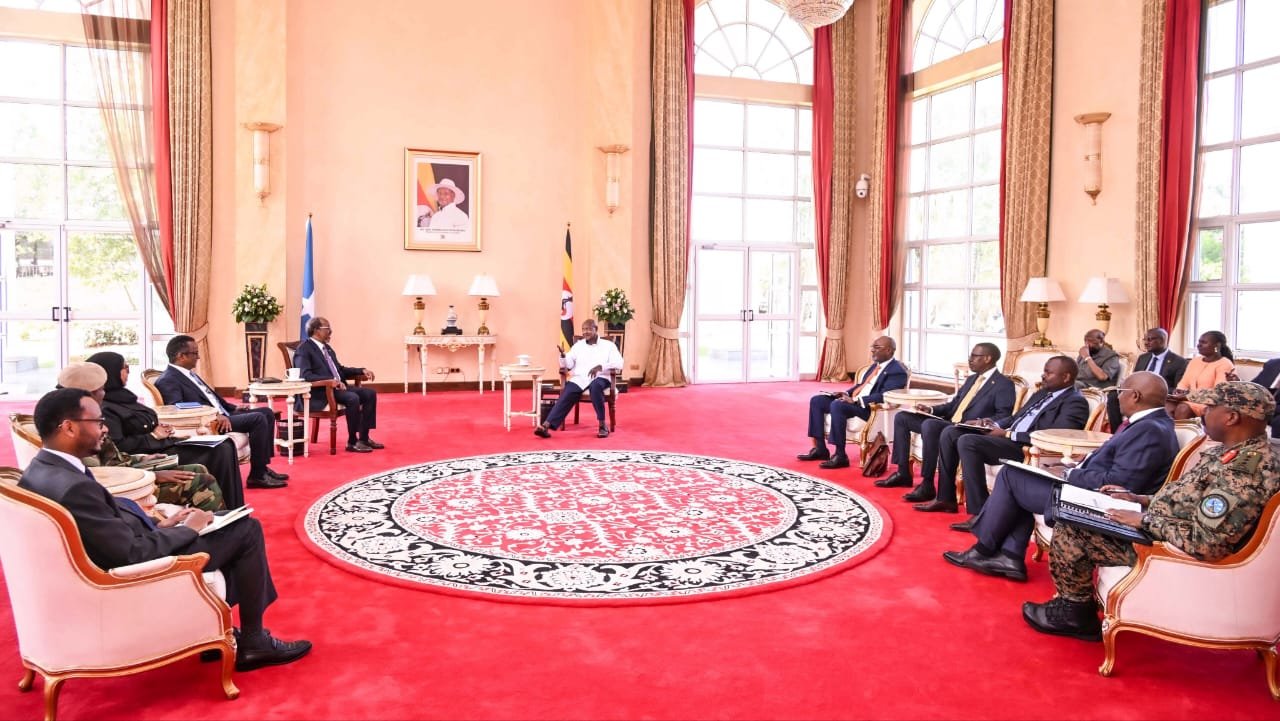
President Yoweri Museveni hosted the talks at State House, Entebbe. Official photographs released after the meeting show the two leaders and their delegations seated in the state rooms beneath a portrait of the Ugandan president. SONNA, Somalia's state news agency, and Ugandan outlets including New Vision carried the communiqué and the pictures.
Money for a mission under strain
The funding appeal is as important as the pledge to attack. The presidents recalled a summit of AUSSOM troop contributors held in Kampala on 31 July, and they paid tribute to Ugandan, Somali and other soldiers killed or wounded in Somalia. They said the gains made since AUSSOM succeeded the African Union Transition Mission in Somalia, and before that AMISOM, needed to be protected.
The communiqué did not say who would pay for the proposed bilateral mechanism, how much money would be required, or when it might arrive. It also did not say whether a new funding arrangement would alter Uganda's withdrawal plans.
That omission is not a minor one. Uganda's military said earlier this month that the first soldiers deployed under the bilateral deal had already gone home and that the rest of that force would follow. It has also begun a staged pull-out of its AUSSOM contingent, with all Ugandan troops due to leave by the end of 2027. Ugandan soldiers serving with the mission recently handed bases around the southern port of Barawe to the Somali army. Uganda was the first country to send troops to the original African Union mission in 2007.
The United Nations Support Office in Somalia, which supplies AUSSOM, has been working under a tighter budget. In an October report, Secretary-General António Guterres said spending in the year to June had been a quarter below the approved amount, limiting transport and resupply. The Security Council is due to decide next month whether to renew the mission's mandate, which expires on 31 December. Those are the financial and political facts around the communiqué. They do not, by themselves, tell us whether Monday's call will produce either more money or a bigger offensive.
Trade, labour and a promised return visit
The Entebbe text was not only a security document. The two presidents welcomed a mid-term review of their Joint Permanent Commission and a business forum held in Mogadishu in October. They noted the signing of a bilateral labour agreement and agreed minutes on an air services deal, and they recalled an October decision to establish a Ugandan warehouse in Mogadishu, with a port facility to be considered "as soon as possible."
They also reaffirmed their commitment to work through the East African Community, IGAD, COMESA and the African Union. Mr Museveni accepted an invitation to visit Somalia, with dates to be set through diplomatic channels.
The communiqué urged Somalia's federal government, federal member states and other stakeholders to strengthen their relations through reconciliation, good governance and peacebuilding. It did not mention Somalia's opposition, the disputed extension of the president's term, or any role for Uganda as a mediator in that crisis.
Whether the pledge of a stronger offensive becomes more than a line in a communiqué will depend on money, on the pace of Uganda's withdrawal, and on what Somali and African Union forces can actually hold. For the moment, the news is what the two governments put on paper in Entebbe: a call to hit Al-Shabaab harder, a search for fresh funds, and a promise that the Ugandan president will come to Mogadishu.