
OYO — 22 November 2026
Kenya and the Democratic Republic of the Congo have agreed to restore full diplomatic relations and to bring their ambassadors back, ending a freeze that has lasted about four years.
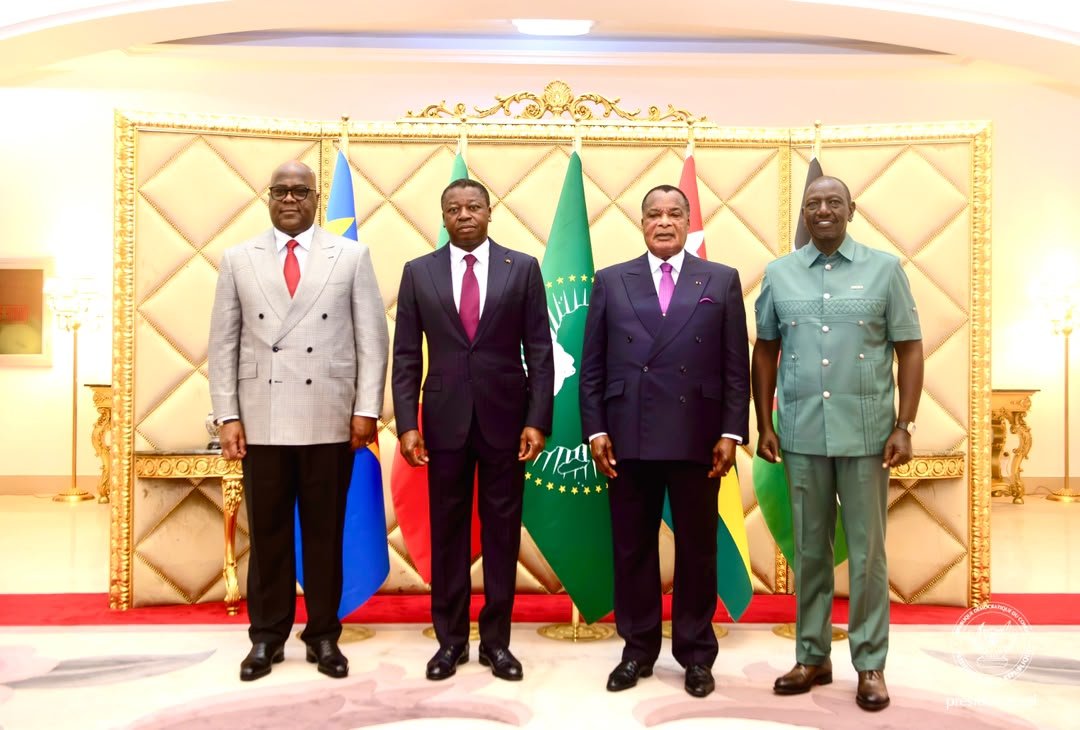
The commitment was made on Sunday at a quadripartite summit in Oyo, in the Republic of the Congo, hosted by President Denis Sassou N'Guesso, with Togo's Faure Gnassingbé present as the African Union's mediator for the crisis in eastern Congo. Official photographs released by the Congolese presidency show Félix Tshisekedi, Mr Gnassingbé, Mr Sassou N'Guesso and William Ruto standing together after the talks.
According to the Congolese presidency and a joint communiqué summarised by both sides, Mr Tshisekedi and Mr Ruto agreed to re-establish diplomatic representation at ambassadorial level, to hold regular political consultations and to resume the Joint Grand Commission for Cooperation. They also pledged to deepen work on trade, investment, security and culture, and to cooperate against Ebola.
What was, and was not, settled
The two presidents reaffirmed their commitment to sovereignty, territorial integrity, non-interference in internal affairs, good-neighbourliness and the peaceful settlement of disputes. They said they would give priority to diplomatic channels and to regional bodies, including the International Conference on the Great Lakes Region and the East African Community, when disagreements arise.
The wording stops short of a dated timetable. Kenyan and other accounts of the meeting have noted that no day has been set for the presentation of credentials. After Kinshasa refused to accredit two successive Kenyan nominees, Shem Amadi and Peter Tum, the practical test will be whether a new ambassador is accepted quickly. In 2025 Kinshasa also protested at Kenya's nomination of a consul-general to Goma, then under the control of the M23 rebellion, a posting that did not go ahead.
How the rift opened
The break dates to December 2023, when Corneille Nangaa, a former Congolese electoral chief, launched the Congo River Alliance in Nairobi, appearing alongside representatives of the M23. Kinshasa recalled its ambassador and accused Nairobi of harbouring rebels. Kenya said it had dissociated itself from the alliance and had no reason to arrest its leaders.
Relations worsened in 2024, when Mr Tshisekedi boycotted an East African Community summit and said Mr Ruto had mishandled the Nairobi peace process. The regional force that had included Kenyan troops had already been sent home. Kenya was left without an accredited ambassador in Kinshasa for much of the dispute. In January 2025, after M23 fighters took Goma, supporters of the Congolese president attacked the Kenyan embassy; Kinshasa later expressed regret, but the diplomatic climate did not improve.
Those are the publicly reported origins of the freeze. Sunday's communiqué did not attempt to relitigate them. It recorded a decision to talk, to send ambassadors back, and to use regional mechanisms rather than public recrimination.
Trade that never quite stopped
Even during the diplomatic winter, commercial ties were not severed. Kenyan banks have a large footprint in the Congo, and the port of Mombasa remains an important gateway for goods bound for the east of the country. Kenya has run a consistent trade surplus with the DRC. A working embassy does not create that commerce, but it makes visas, permits and ordinary disputes easier to handle.
The Oyo meeting was also framed, in Kinshasa's account, as part of a wider African effort to ease regional tension, including the conflict in the east of the Congo. The Washington and Doha processes involving Rwanda and the M23 have not produced a durable ceasefire. Sunday's talks, however, were about the Nairobi-Kinshasa relationship, not a new peace deal with Kigali, and no such deal was announced.
Mr Ruto and Mr Tshisekedi thanked Mr Sassou N'Guesso and Mr Gnassingbé for convening the summit and creating room for a rapprochement. The hosts, for their part, have an interest in calmer relations along a corridor that runs from Mombasa toward the Congo River.
An ambassador's return will not end the war in the east, and it will not by itself repair four years of suspicion. It would, if it happens, restore a channel that has been closed for too long. The measure of Sunday's agreement is not the photograph in Oyo. It is whether credentials are accepted in the weeks ahead.