
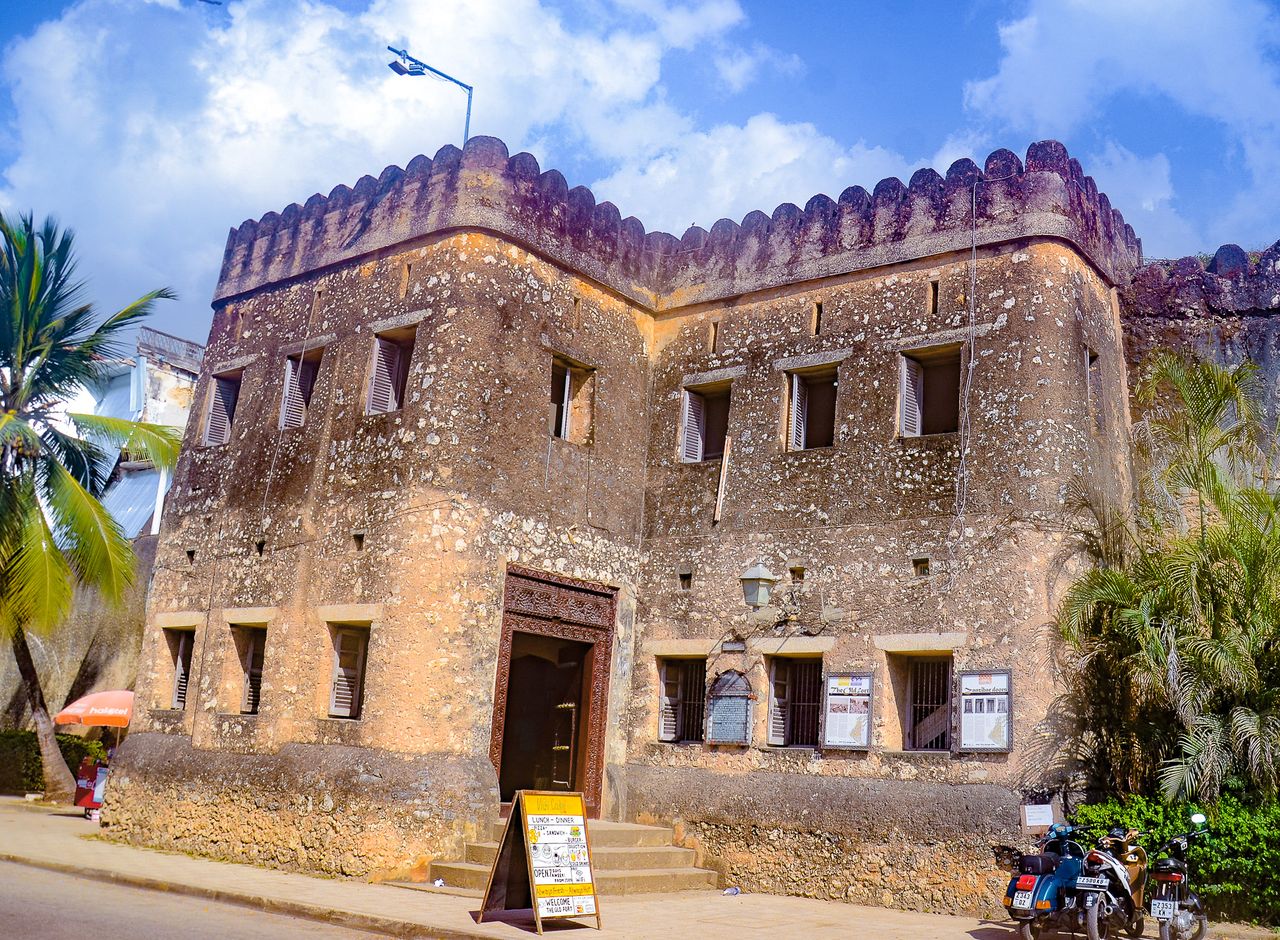
The history of the East African coast is written into its architecture. In Zanzibar, enormous wooden doors carved with intricate patterns stand at the entrances of old merchant houses. In Mombasa, the walls of Fort Jesus overlook a harbour once contested by Portuguese soldiers and Omani forces. Farther north, the fortified settlements of Lamu and Pate preserve the memory of a political order that connected the Arabian Peninsula with the African mainland.
These structures are remnants of an extraordinary chapter in Indian Ocean history: the rise of the Omani Empire, an Arabian dynasty whose political and commercial influence extended from the Strait of Hormuz down the East African coastline towards Cape Delgado, in present-day Mozambique.
At its nineteenth-century height, the empire connected Arabia, Zanzibar and the Swahili coast through maritime commerce, military installations and political alliances. In 1832, Sultan Said bin Sultan transferred his capital from Muscat to Zanzibar, making an African island the principal seat of an empire founded in Arabia.
The move was unusual in the history of imperial expansion. Rather than establishing an African capital as a distant colonial outpost, Said made Zanzibar the centre of his political and commercial ambitions.
The empire eventually divided following his death in 1856. Yet its legacy did not disappear with the dynasty’s political separation. Across Kenya, Tanzania and northern Mozambique, its influence survives in historic buildings, Islamic institutions, Swahili culture, commercial traditions and the history of slavery.
The conquest that changed the Swahili coast
The Omani expansion into East Africa emerged from a prolonged struggle against Portuguese domination of Indian Ocean commerce.
Portugal had established military and commercial positions along the East African coast from the early sixteenth century, seeking to control maritime routes connecting Africa, Arabia and India. Its occupation of Muscat in 1507 also threatened Oman’s commercial independence.
The expulsion of the Portuguese from Muscat in 1650 transformed Oman’s position. Its rulers subsequently developed a formidable navy and began challenging Portuguese installations across the western Indian Ocean.
The most consequential confrontation occurred at Mombasa, where Portuguese authority was symbolised by Fort Jesus, constructed in 1593.
In March 1696, Omani forces began a siege that would last approximately 33 months. The Portuguese garrison became increasingly isolated as food supplies diminished and disease spread. Omani naval forces restricted maritime access while the defenders struggled to obtain provisions from the mainland.
The outcome was not determined by naval power alone. African communities, particularly Mijikenda groups, played important roles in the commercial and food-supply networks surrounding Mombasa. Their changing relationships with the competing powers affected the survival of the Portuguese garrison.
In December 1698, Omani forces captured Fort Jesus.
The victory weakened Portuguese authority along the Swahili coast and opened the way for a stronger Omani political presence. But the fortress changed hands again in 1728, when Portugal temporarily recovered it. The restored occupation collapsed following local resistance, and Omani influence returned.
The fortress remains one of the most important physical records of this confrontation. Today, it is a UNESCO World Heritage Site, preserving evidence of successive Portuguese, Swahili and Omani political authorities.
Its history also challenges the idea that East Africa was merely a passive battleground between foreign empires. Local communities helped determine the outcome of the struggle.
When an Arabian empire moved its capital to Africa
The transformation of Omani power reached its height under Said bin Sultan, who ruled from 1806 until 1856.
Zanzibar offered strategic advantages that Muscat could not match. Situated along important Indian Ocean shipping routes and close to the African mainland, the island provided access to ivory, agricultural commodities and commercial networks extending into the interior.
In 1832, Said transferred his political capital from Muscat to Zanzibar. The decision established the island as the principal centre of his expanding East African interests.
Zanzibar subsequently developed into a major international trading centre, attracting Arab, Indian, European and African merchants. Its harbour connected the African mainland with markets across the Indian Ocean.
Said strengthened political relationships with coastal settlements, appointed representatives and sought to consolidate control over strategically important ports. His commercial relationships also extended towards the African interior, where trading agents connected coastal markets with distant communities.
But the empire was never a uniformly administered territory. The sultan’s authority was strongest in Zanzibar and selected coastal settlements. Farther inland, political relationships depended heavily on local rulers, merchants and trading networks.
Historian Valerie J. Hoffman describes this distinction in her study of the Sultanate of Muscat and Zanzibar, noting that the dynasty appointed governors along the coast and maintained agents as far inland as the Congo, while actual territorial control remained weak.
The empire was therefore better understood as a maritime political and commercial network than as a centrally governed territorial state.
The forts that survived the empire
The most visible remnants of Omani power are found in the military structures established along the Swahili coast.
In Zanzibar, the Old Fort, or Ngome Kongwe, stands beside the historic waterfront. Originally developed in the late seventeenth century, it became an important defensive and administrative installation during the period of Omani ascendancy.
Its location reflects the importance of controlling the harbour and protecting the commercial centre that developed around it.
Farther north, Lamu Fort preserves another part of this history. Constructed in the nineteenth century, it reflects the military and political environment of the coastal sultanates, although its history also involves local Swahili authorities and the Mazrui dynasty.
On Pate Island, Siyu Fort provides evidence of the political competition that shaped the northern Swahili coast. Its fortified walls and defensive towers reflect the strategic importance of protecting trading settlements and their surrounding territories.
Further south, the ruins and fortifications of Kilwa demonstrate the importance of the southern Swahili coast to regional commerce.
Research by Stéphane Pradines and Pierre Blanchard, published in 2019, examines these Omani fortifications and their relationship to military architecture across the Indian Ocean. The authors identify the strategic importance of installations at Zanzibar, Lamu, Siyu and Kilwa.
These buildings were not merely defensive structures. They protected trading activities, housed military personnel and communicated political authority.
Their survival provides a geographical record of the commercial and military system that connected Zanzibar with the wider East African coast.
The architectural legacy of Zanzibar
The most enduring expression of Omani influence is perhaps found in Stone Town, the historic heart of Zanzibar.
Its narrow streets, coral-stone buildings, elaborate wooden doors and imposing merchant residences reflect centuries of interaction between African, Arabian, Indian and European communities.
During the nineteenth century, the island experienced substantial commercial expansion. Wealthy merchants and members of the ruling elite constructed multistorey residences, palaces and commercial buildings.
The resulting architectural culture combined Swahili traditions with imported Arabian and Indian influences.
The House of Wonders, commissioned by Sultan Barghash bin Said in the late nineteenth century, became one of the most recognisable symbols of the Zanzibar Sultanate. Although built after the death of Said bin Sultan, it represents the continuation of the political and architectural traditions established under the Al Bu Said dynasty.
The UNESCO World Heritage Centre describes Stone Town as an exceptional example of a Swahili trading settlement that brought together architectural and cultural influences from Africa, Arabia, India and Europe.
That description is important. Zanzibar’s architecture cannot be attributed exclusively to Oman. The Swahili civilisation had developed sophisticated urban and commercial traditions long before the Al Bu Said dynasty established its political centre on the island.
The Omani period added another layer to this heritage, helping produce the distinctive urban landscape that survives today.
The wealth behind the architecture
The commercial prosperity of the Omani Empire was inseparable from slavery and the exploitation of African labour.
Said bin Sultan encouraged clove cultivation on Zanzibar and Pemba, establishing a plantation economy that relied heavily on enslaved Africans.
The ivory trade also expanded dramatically. Caravans travelled inland from coastal settlements, connecting merchants in Zanzibar with African communities across the interior.
Enslaved people were transported towards the coast, where they were sold locally, sent to plantations or exported across the Indian Ocean.
Indian financiers, Arab merchants and Swahili traders participated in different parts of this commercial system. European and American buyers also contributed to the international demand for ivory and other commodities.
Historian Abdul Sheriff documents these relationships in Slaves, Spices and Ivory in Zanzibar, showing how the island became integrated into the expanding international economy.
The physical legacy of this history remains visible in Stone Town.
Christ Church Cathedral stands on the site of the former slave market, which was closed in 1873 following British intervention. Nearby, the slave memorial commemorates the Africans who were captured, transported and sold through the island’s commercial networks.
These sites provide an essential counterpoint to the architectural splendour of the old town.
The wealth that financed Zanzibar’s palaces and merchant houses was partly generated through an economy built on human exploitation. Any account of the Omani legacy that celebrates its architecture without examining slavery presents an incomplete history.
From Zanzibar to Mozambique
The geographical reach of Omani influence extended well beyond Zanzibar.
Along the northern coast, Mombasa and Lamu were important centres of political and commercial activity. Farther south, Kilwa and other Tanzanian settlements connected the sultanate to trading networks approaching northern Mozambique.
Cape Delgado, in present-day Mozambique, is frequently identified as the southern geographical limit of the Omani sphere of influence.
However, this should not be interpreted as evidence that the sultan directly administered every territory between Zanzibar and Mozambique. Local African authorities continued to exercise political power, while Omani influence varied according to the strategic importance of individual ports and commercial relationships.
The southern coastal connections were nevertheless significant. They linked the Swahili trading system with commercial routes extending into southeastern Africa.
The empire’s legacy was therefore not limited to a handful of islands or ports. It formed part of a much wider maritime world connecting East African communities with Arabia, India and international markets.
The empire divided, but its legacy endured
Said bin Sultan died in 1856, leaving a succession dispute between his sons, Thuwaini bin Said and Majid bin Said.
Thuwaini consolidated his authority in Oman, while Majid established himself in Zanzibar. The political disagreement threatened the unity of the territories inherited from their father.
British arbitration formally recognised the separation in 1861, establishing two distinct sultanates.
Zanzibar subsequently became a British protectorate in 1890, although the Al Bu Said dynasty continued to rule until the revolution of January 1964.
The political division did not erase the commercial, cultural and architectural connections that had developed during the empire.
Arabic vocabulary remains deeply embedded in Kiswahili, although the language’s foundations are Bantu. Islamic scholarship, religious institutions, coastal architecture and family histories continue to reflect centuries of interaction between East Africa and Arabia.
The legacy is also visible in the historic towns that remain along the coastline. Fort Jesus, Stone Town, Lamu and Siyu preserve different aspects of the political and commercial world created during the centuries of interaction between African and Arabian powers.
The Omani Empire is therefore not simply a story of an Arabian dynasty that expanded into Africa. It is part of East Africa’s own history, shaped by Swahili merchants, African political authorities, international trade and the consequences of slavery.
More than a century and a half after its political division, its physical remains continue to connect the East African coast to a period when Zanzibar was the centre of an empire stretching from Arabia towards Mozambique.
The sultans are gone, but the forts, palaces, trading towns and cultural traditions remain. They tell the story of an empire that was founded in Arabia, governed from Africa and ultimately became inseparable from the history of the Swahili coast.