
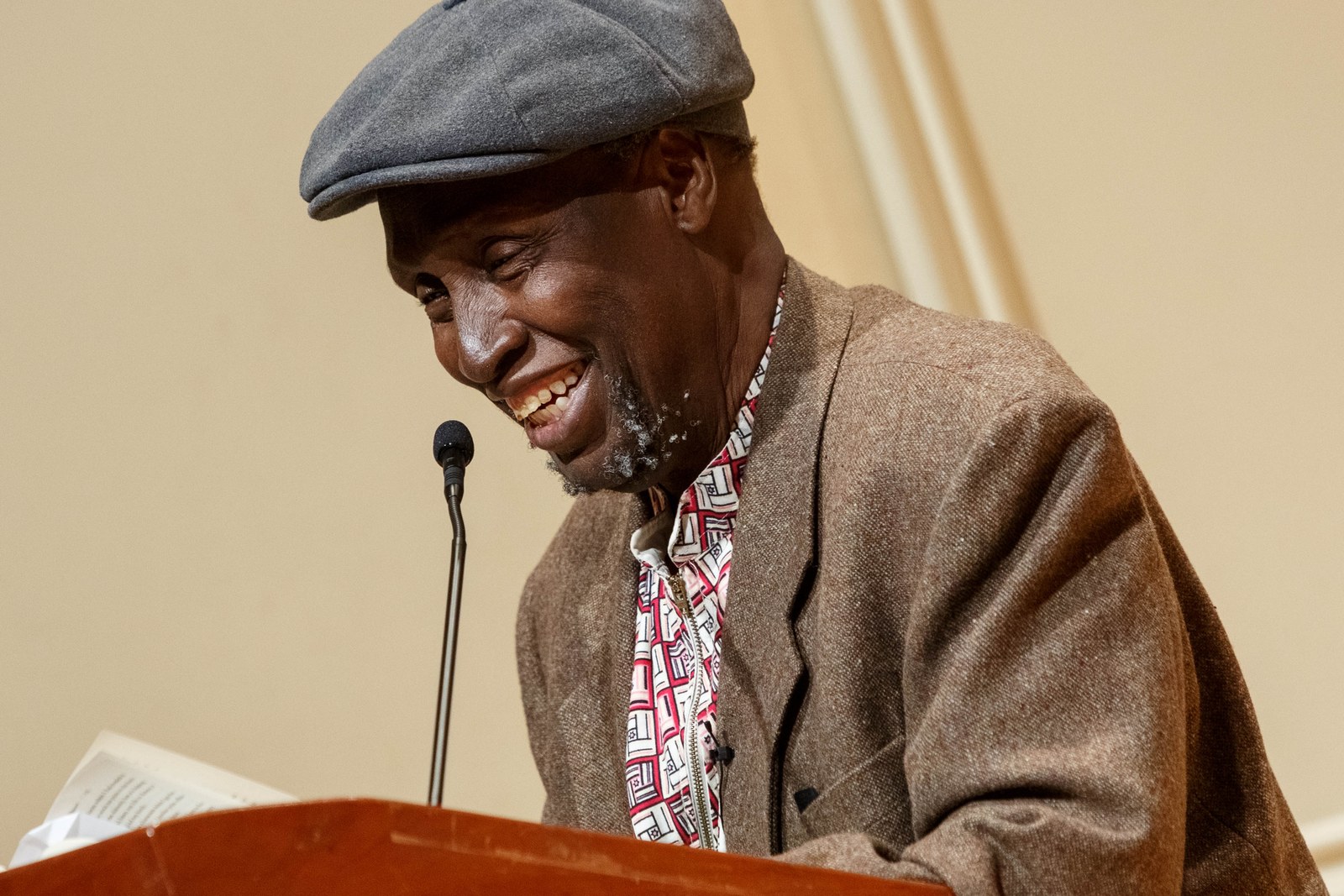
Ngũgĩ wa Thiong’o, the Kenyan writer, was born in 1938. Early in his career he was published under the name James Ngugi. Around 1970 he adopted the name Ngũgĩ wa Thiong’o, and it was under that name that his work became known around the world. He died in 2025, aged 87.
The change was a rejection of colonial identity, not a literary flourish. The name James Ngugi had been carried through the colonial education system. In choosing to be known as Ngũgĩ wa Thiong’o, he claimed the right to name himself. Colonial missionary naming, like the renaming of enslaved Africans, was one of the ways in which African identities were overwritten by the authority of others.
Ngũgĩ’s commitment to African languages was not merely a literary preference. He wanted literature and theatre to become accessible to the people whose experiences they represented.
In 1977, he collaborated with fellow Kenyan writer Ngũgĩ wa Mĩriĩ to produce Ngaahika Ndeenda (I Will Marry When I Want), a Gĩkũyũ-language play performed by workers and peasants at the Kamĩrĩĩthũ Community Education and Cultural Centre in Limuru.
The production challenged the conventional relationship between African intellectuals and ordinary people. Instead of producing theatre primarily for university audiences and English-speaking urban elites, Ngũgĩ brought literature into the community, using the language spoken by local residents.
The play examined landlessness, class inequality, exploitation, corruption and the betrayal of the promises of independence. Its popularity demonstrated the political potential of a theatre rooted in ordinary people’s experiences.
The Kenyan authorities viewed the production with hostility. Performances were banned in November 1977, and Ngũgĩ was arrested on 31 December that year. He was detained without trial at Kamiti Maximum Security Prison and released in December 1978 following an international campaign.
It was during his imprisonment that he wrote his first Gĩkũyũ novel, Caitaani Mũtharaba-Inĩ, subsequently published in English as Devil on the Cross (1982). He famously wrote the manuscript on toilet paper because conventional writing materials were unavailable to him.
His imprisonment reinforced his conviction that language, literature and popular participation were not separate from political freedom. The state could tolerate African literature as an academic subject, but it became more threatening when ordinary people used it to question the distribution of power.
Ngũgĩ subsequently spent many years in exile, first in Britain and later in the United States. His experience demonstrated that political independence had not necessarily eliminated authoritarianism or the suppression of dissent in African states.
Decolonisation: Reclaiming more than a name
Ngũgĩ’s intellectual project raises a fundamental question for contemporary Africa: what does independence mean when the institutions, languages and cultural hierarchies of colonial rule continue to shape society?
His answer was that decolonisation must extend beyond political sovereignty. It must involve the recovery of African languages, histories, intellectual traditions and the right of African societies to define their own development.
This does not necessarily mean rejecting everything European or abandoning international languages. Rather, it means challenging the assumption that European cultural and intellectual traditions should occupy a superior position while African knowledge is treated as secondary.
There is also a practical dimension to this argument. Across much of Africa, English, French and Portuguese remain dominant in higher education, government administration and formal economic institutions. Millions of Africans encounter public institutions through languages they may not speak as their first language.
This creates questions about educational access, political participation and whose knowledge is considered authoritative.
Ngũgĩ’s position was particularly demanding because he did not simply advocate the symbolic recognition of African languages. He demonstrated his commitment by producing novels, plays and essays in Gĩkũyũ, even when doing so presented considerable challenges to international publishing and readership.
His position nevertheless generated debate. Critics have questioned whether abandoning English risks limiting the international circulation of African literature and whether multilingual societies can realistically organise intellectual life around indigenous languages alone.
These are legitimate questions. But they do not undermine his central argument: African languages should not be regarded as obstacles to modernity, intellectual achievement or global participation.
The challenge is to build institutions capable of developing African languages as languages of science, scholarship, administration and public debate, while enabling Africans to participate in the wider world.
The unfinished struggle
Ngũgĩ wa Thiong’o’s legacy extends beyond Kenya and beyond literature. His work belongs to a broader African intellectual tradition concerned with the relationship between colonialism, cultural identity, economic power and the meaning of independence.
His decision to reclaim his name was a personal act with wider political significance. His decision to write in Gĩkũyũ transformed that symbolism into a sustained intellectual commitment.
For contemporary Africa, the implications remain important. The continent cannot fully understand its development challenges without examining the historical structures that continue to influence its education systems, public institutions, economic relationships and cultural hierarchies.
Decolonisation is not simply about removing colonial monuments, changing national flags or replacing foreign administrators with African leaders. It also requires examining the ideas, institutions and assumptions that determine whose histories are remembered, whose languages are respected and whose knowledge is valued.
Ngũgĩ’s life offered a powerful reminder that colonialism can survive in the mind long after the colonial administration has departed.
He reclaimed the name James Ngugi had once carried through the colonial education system and chose instead to be known as Ngũgĩ wa Thiong’o. In doing so, he challenged a world in which African identity was too often defined through the authority of others.
His message remains relevant to a new generation: political freedom without cultural and intellectual freedom is an unfinished independence.
The struggle to decolonise Africa is therefore not only about who governs the continent. It is also about who defines its identity, controls its knowledge and tells its history.
Sources and further reading
- Ngũgĩ wa Thiong’o, Decolonising the Mind: The Politics of Language in African Literature (1986).
- Ngũgĩ wa Thiong’o Foundation, Biography and intellectual history.
- London School of Economics, Ngũgĩ wa Thiong’o: Decolonising Your Mind.
- SOAS University of London, Ngũgĩ wa Thiong’o manuscripts and the Heinemann African Writers Series.
- The Guardian, Ngũgĩ wa Thiong’o obituary, 8 June 2025.
- Laura Álvarez López, Who named slaves and their children? Names and naming practices among enslaved Africans brought to the Americas and their descendants with focus on Brazil (2015).
- Reuters, Ngũgĩ wa Thiong’o, Kenyan author who reckoned with colonial legacy, dies at 87.
Editorial note: The comparison between colonial missionary naming and the renaming of enslaved Africans is intended to illuminate related mechanisms of cultural domination, not to suggest that the historical experiences were identical.