
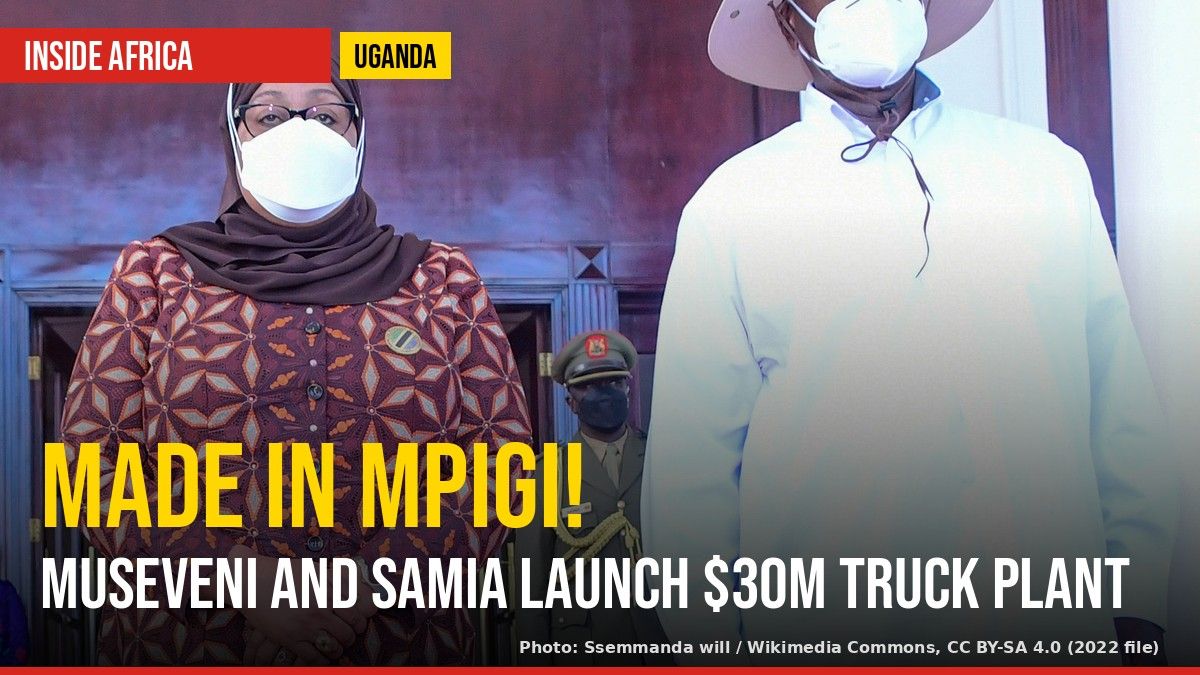
MPIGI — Uganda has opened a $30 million truck assembly plant with a capacity of 4,000 heavy-duty lorries a year, launched jointly by President Yoweri Museveni and Tanzania's President Samia Suluhu Hassan.
The Double Q Automotive Assembly Plant in Nakirebe, Mpigi District, west of Kampala, was opened on Thursday, 19 November, at the end of Samia's two-day state visit to Uganda, State House Uganda said. Galaxy FM's post about the launch drew more than 2,600 likes on X, and clips of the two leaders touring the factory were widely shared by Ugandan and Tanzanian accounts.
The plant
According to State House, the facility sits on 45 acres of land and assembles Sinotruk heavy-duty trucks. It also represents the international brands GMC and XCMG in Uganda.
Works and Transport Minister Fred Byamukama said the plant directly employs more than 1,200 Ugandans, many trained through government skills programmes and on the job. He said the lowest-paid worker earns about 800,000 shillings a month.
Museveni said the facility already builds truck bodies locally, adding about 20% of local value. That is important: the plant mainly assembles vehicles from imported parts, rather than making complete trucks from scratch. Its owners and the government say they want to change that over time.
From transporter to truck maker
Double Q's managing director, Lin Yu, said the company began in Uganda in 2013 transporting construction materials. It moved into Sinotruk spare parts, after-sales service and leasing, became the official Sinotruk distributor in 2017 and began assembling trucks locally in 2020. More than 5,000 trucks have since been assembled through its Ugandan operations, he said.
The company plans to expand into passenger vehicles and electric trucks, he said. "We want to buy more materials locally, make more truck parts in Uganda, and expand our work in metal fabrication, engineering, and logistics."
Byamukama said the government is discussing plans for Double Q to build a tyre factory at Kayunga Industrial Park. The company is also developing training partnerships with Kyambogo University, Uganda Christian University and Nakawa Vocational Institute.
Museveni: link it to Ugandan steel
Museveni thanked the company and its Chinese partners and urged them to connect vehicle assembly with Uganda's steel industry. "On behalf of Uganda, I want to thank you so much for investing in Uganda, to assemble trucks, and also to build local parts, and eventually link up with the local steel industry," he said.
He said Uganda's iron ore and Tanzania's natural gas could be combined. "You find that Tanzania has got gas, Uganda has got iron ore, and other products. So, when you put them together, instead of using them in a fragmented way, you will do better business," he said.
He called for a united African market. "This is not just music; it is showing the future. If you want to succeed, you need a united market for Africa."
Samia: do not compete with each other
Samia praised the plant as a milestone and urged East African countries to move from mainly agricultural economies to industrial production. "Let us turn from being consumers of imported goods to regional production and marketing hubs. We should aspire to manufacture, assemble, and produce," she said.
She warned against neighbours setting up rival copies of the same industries. Noting that Sinotruk also operates in Tanzania, she said the investments should be seen as chances for cooperation. "East Africa must compete with the world, not within itself," she said.
She welcomed proposals for harmonised regional rules on vehicle assembly, and said Tanzania is exploring partnerships to build a railway locomotive plant. She also cited the Port of Dar es Salaam, which she said handled about 33 million tonnes of cargo in 2026, as evidence of growing demand for transport.
China's role
China's ambassador to Uganda, Wu Guangrong, said the presence of both presidents gave investors confidence, and urged Chinese companies to follow local laws, keep workers safe, protect the environment and develop local talent.
Sinotruk International's general manager, Song Yang, said the company expects to sell more than 360,000 heavy trucks worldwide in 2026, about 110,000 of them in Africa.
A wider partnership
The launch capped a visit in which the two presidents also agreed to fast-track the East African Crude Oil Pipeline and standard gauge railway projects, according to State House.
Why it matters
East Africa imports most of its vehicles, often second-hand, and trucks are the backbone of regional trade, carrying goods from the ports of Dar es Salaam and Mombasa to landlocked Uganda, Rwanda, South Sudan and Congo. Local assembly can cut costs, create jobs and build skills.
The test will be whether plants like this move beyond assembly into real manufacturing of parts and steel, and whether regional governments coordinate rather than compete, as Samia urged.
What comes next
Watch for the proposed tyre factory, the first locally made parts and any new regional rules on vehicle assembly. Double Q also says it operates in Kenya, Tanzania, Rwanda, South Sudan, Congo and Zambia, so its next moves could shape the wider regional market.