
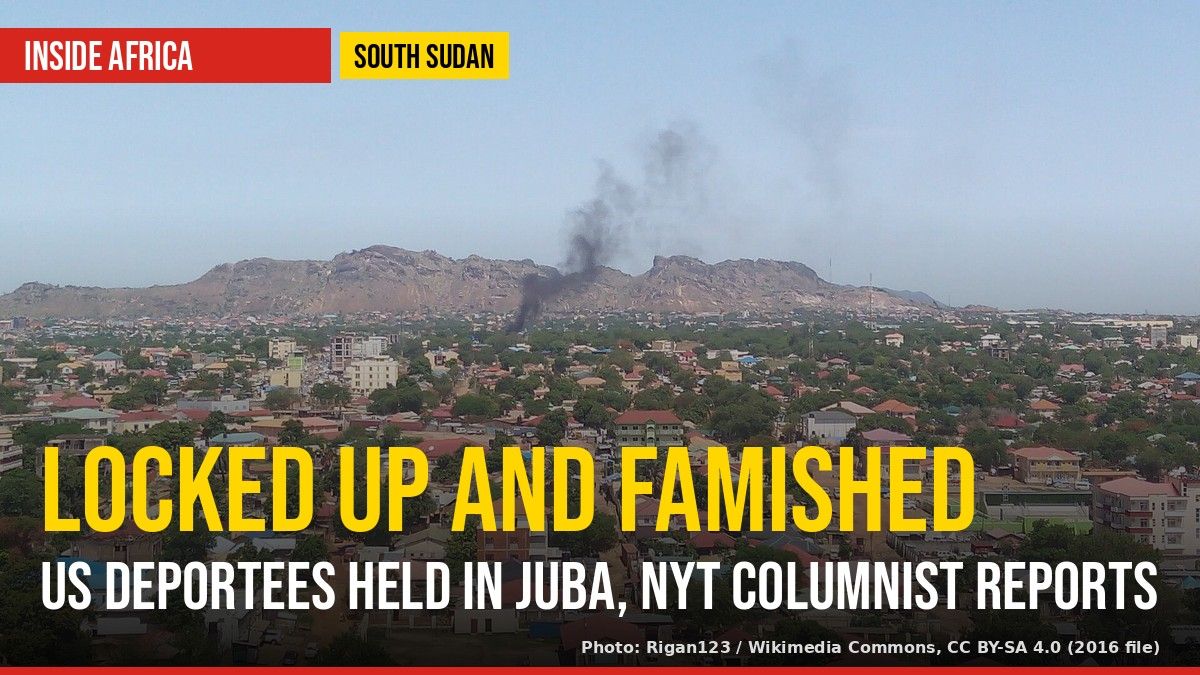
JUBA — Five men deported from the United States to South Sudan are being held under guard in a house in Juba, short of food and water and unable to contact their families freely, according to a report by New York Times columnist Nicholas Kristof.
Kristof's column, published on 18 November, set off a storm online. His post about it drew more than 8,000 likes and almost 500,000 views on X, with thousands of people sharing it across Africa and the United States.
What Kristof found
Kristof wrote that he found the five men this month in what the South Sudanese government calls a "safe house" behind a high wall and a locked gate, with several guards always present. He said the house itself is spacious and "not at all like a prison", but the men are not allowed to leave, have phones or contact anyone.
The men told him that electricity and toilets often fail. Their biggest complaint, he wrote, was a lack of food and water. One man said he had lost 14 kilograms, and another more than 20. Most of the time, they said, each man receives three litres of water every two days, for drinking, washing and flushing the toilet.
"I don't know if I can tell you without being killed, but it's horrible here," Enrique Arias Hierro, a 48-year-old Cuban who had lived in the United States since he was two, told Kristof. The interview was monitored by South Sudanese guards and a diplomat. "I'll take the consequences," Arias Hierro said.
The men said they had not been beaten, and that they understood South Sudan has limited resources. They acknowledged that one had received dental care and others treatment for malaria.
Kristof wrote that South Sudan gave the men new clothes, a good meal and plenty of water before his visit, fixed the lights and lit incense to cover odours.
The Associated Press has separately reported that relatives of the deportees say the men went hungry while guards pocketed money sent by their families. Inside Africa has not independently verified the conditions described.
Who the men are
Two of the men are from Cuba and two from Myanmar. Kristof wrote that at least four of the five have criminal records, including for attempted murder and armed robbery. South Sudan says they completed their sentences in the United States before they were deported.
Cuba has refused to take back Arias Hierro or a second Cuban, Rodríguez-Quiñones, Kristof reported. The two men from Myanmar belong to the Karen minority, which the Myanmar military is fighting in a civil war, and said they would like to be sent to refugee camps in Thailand.
South Sudan managed to send three other deportees home, to Mexico, Laos and Vietnam.
What the governments say
A spokesperson for the US Department of Homeland Security told Kristof that the deportees "were so heinous even their own countries would not take them back", adding: "We will not allow barbaric criminal illegal aliens to terrorise American citizens."
South Sudan said in a statement that it "covers the cost of their accommodation, provisions, administration and medical care from its own national resources", and that "the United States government made no financial provision toward these expenses". It says it allows the men to contact their families and lawyers; their lawyers dispute that, according to Kristof.
A South Sudanese diplomat at the meeting noted that much of the country itself lacks food and water, and suggested the United States should pay for the men's costs.
How they ended up in Juba
The US Supreme Court allowed deportations to South Sudan last year. Kristof reported that the court has scheduled fast-track hearings in December on whether deportations to third countries violate the US Constitution and international protections against torture.
He wrote that the Trump administration has deported more than 500 people to African countries with which they have no connection. South Sudan at first resisted taking some deportees, he reported, until Secretary of State Marco Rubio imposed a ban on visas for all South Sudanese. The country then agreed.
According to a report by Democrats on the US Senate Foreign Relations Committee, cited by Kristof, the transfer of eight people to South Sudan via Djibouti cost more than $700,000. The same report quoted an unnamed US official as saying of third-country deportations: "The point is to scare people."
Human Rights Watch, in an October report, described the practice as a policy "designed to instrumentalise human suffering as a deterrent to migration".
Why it matters
South Sudan is one of the world's poorest countries and has struggled with conflict and hunger since independence in 2011. Kristof noted that a child under five dies there about every 15 minutes on average, mostly from preventable causes. Asking such a country to house deportees with no links to it raises serious humanitarian questions.
The case also shows how African countries are being drawn into US immigration policy. Other deportees have been sent to Ghana, the Central African Republic and Congo, Kristof reported.
What comes next
The US Supreme Court's December hearings could decide whether third-country deportations continue. For the five men in Juba, the question is simpler: whether anyone will take them, and when they will be allowed to leave.
Sources
- Nicholas Kristof, New York Times, via NZ Herald: Trump "disappeared" them in 2025. I found them, locked up and famished
- AP: US deportees in South Sudan went hungry as guards pocketed money from relatives, families say
- Human Rights Watch: US expulsions of third-country nationals to countries in Africa
- Nicholas Kristof on X