HARGEISA, Somaliland
The authorities in Somaliland executed nine men by firing squad on 11 November after the president authorised their death sentences, according to the Somaliland Human Rights Monitoring Group (SHRMG). The executions have prompted the group to call for an independent investigation, and they raise serious questions about whether the territory's courts gave the condemned men the basic protections that the law requires before a state takes a life.
The United Nations Human Rights Office condemned the killings. “We are deeply disturbed by the execution of nine men in Hargeisa on 11 November following murder trials conducted in military court that, in addition, fell short of international fair trial and due process standards,” Seif Magango, a spokesperson for the office, said in a statement issued in Geneva on 18 November.
“We call for any pending executions to be halted,” Mr. Magango said. “More generally, we urge establishment of a moratorium on executions across Somalia, with a view to eventual abolition of the death penalty.” He added: “The death penalty is fundamentally incompatible with human dignity and rights, including the right to life and the right not to be subjected to cruel, inhuman or degrading treatment or punishment. Furthermore, evidence suggests it is ineffective in deterring crime.”
The office also posted its condemnation on X, where it has drawn more than 54,000 views.
View on X#Somalia: We are deeply disturbed by the execution of nine men in Hargeisa on 11 November following murder trials conducted in military court.
We call for any pending executions to be halted, and urge a moratorium on executions, with a view to eventual abolition of the death penalty.
SHRMG and local media say the executions took place at Mandera, in the Sahil region, while the UN statement refers to Hargeisa. Media reports say most of the nine had served in the security forces. The full judgments, appeal records and case files have not been made public.
The case of Akram Buraale Ahmed
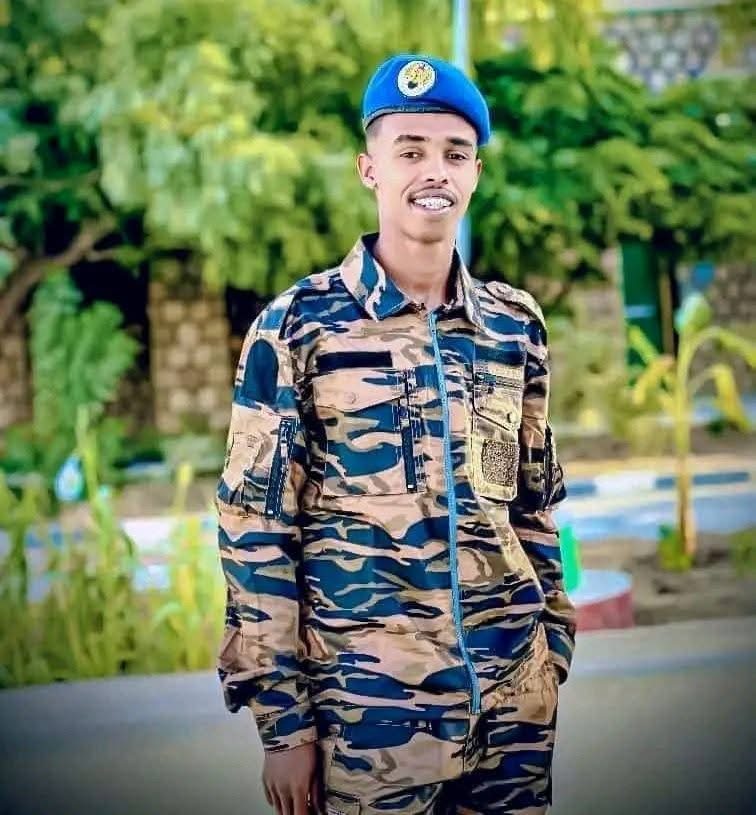
One of the men was Akram Buraale Ahmed. In a statement published on 15 November, SHRMG said "information received" indicated that Akram had taken part in a government-directed security operation in Erigavo in 2024 during which a person was accidentally shot and killed.
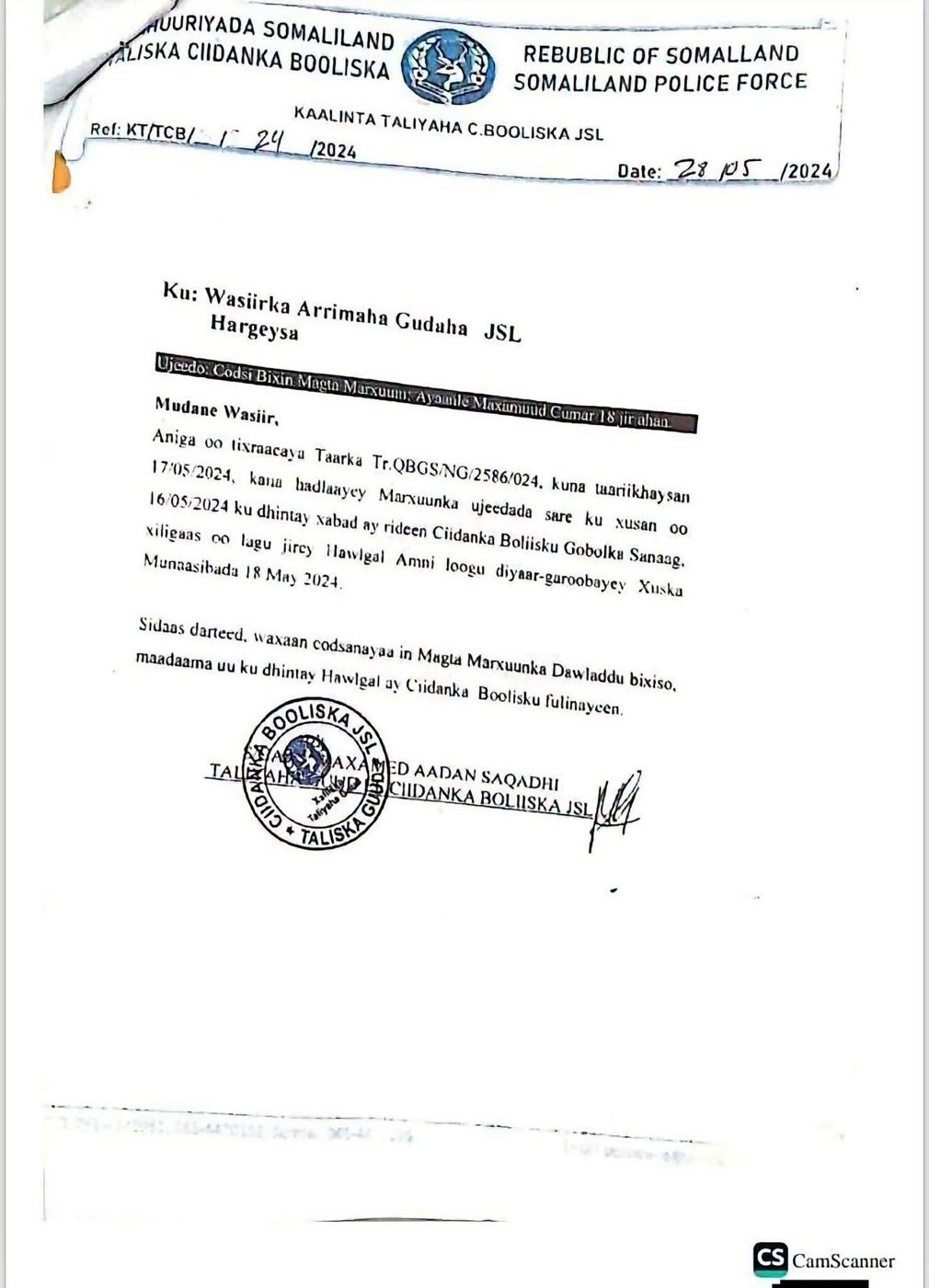
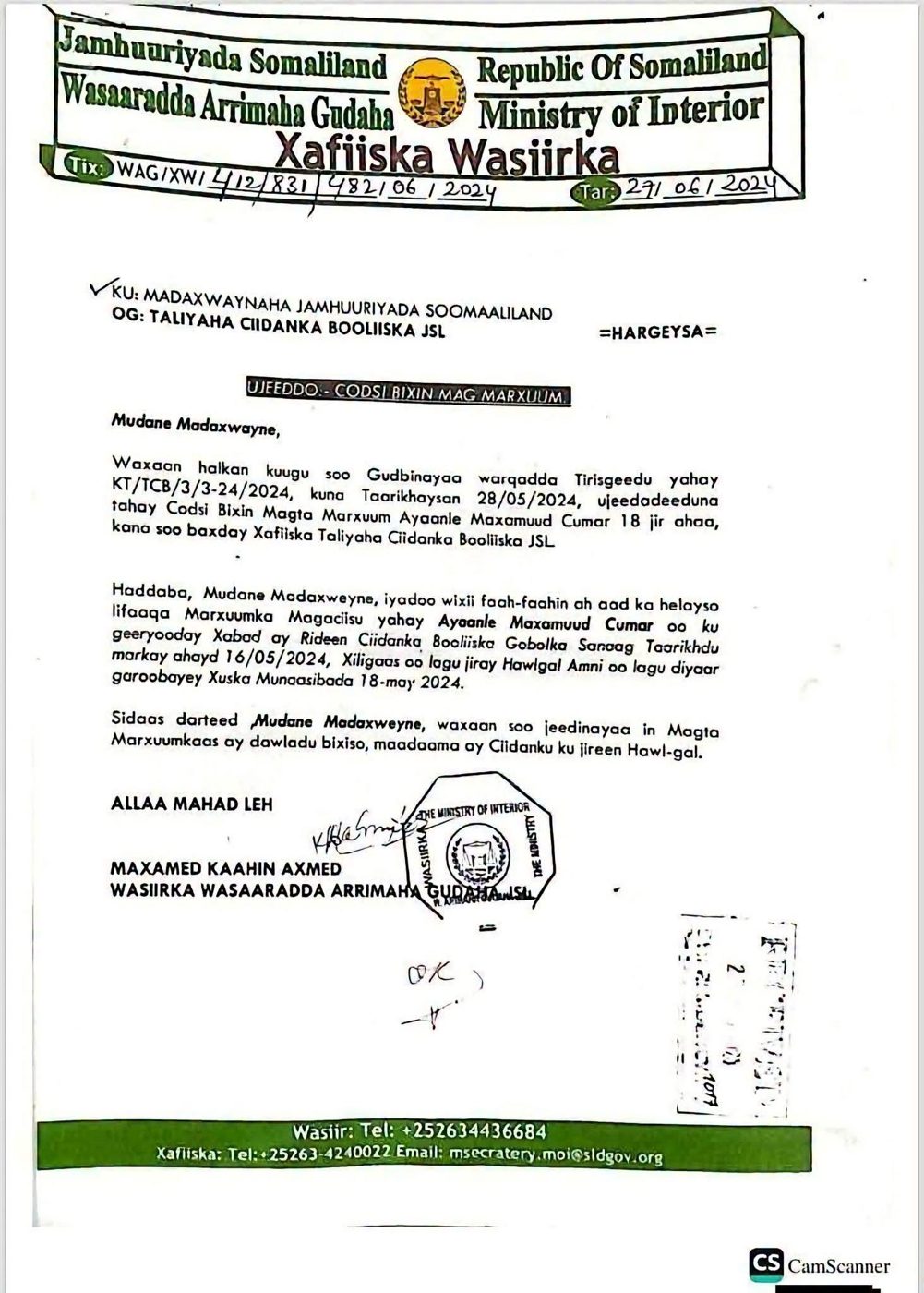
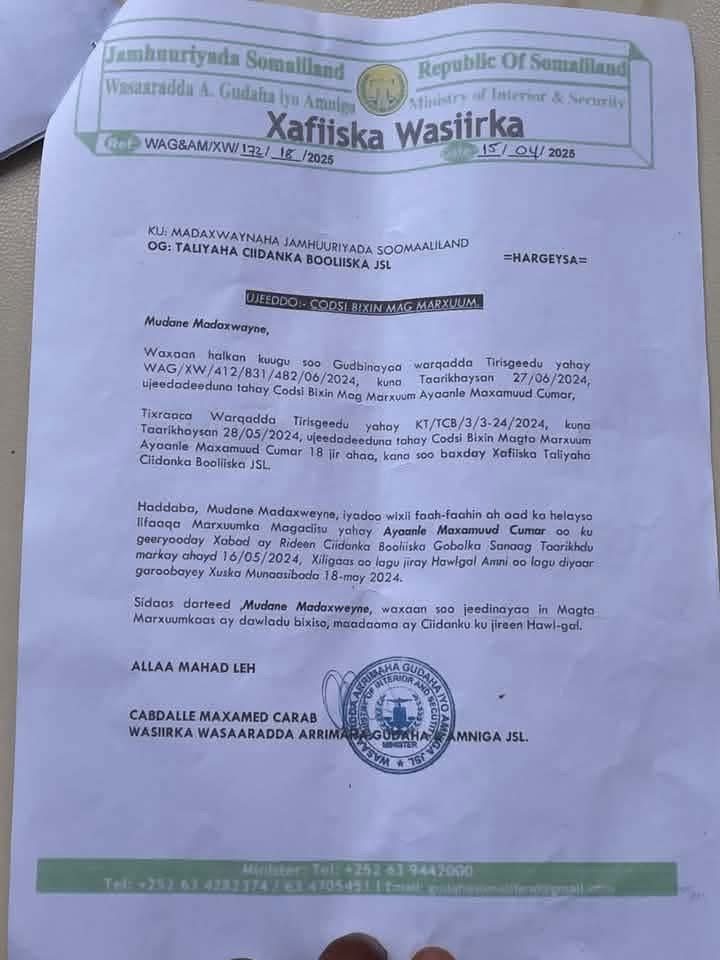
The government's own correspondence tells a different story. Three official letters, published by SHRMG with its statement and reproduced below, concern the death of 18-year-old Ayaanle Maxamuud Cumar, who was shot dead in Erigavo on 16 May 2024 during a security operation ahead of the 18 May national day. The letters attribute the shooting to the Sanaag regional police. They do not name Akram.
In a letter dated 28 May 2024 (reference KT/TCB/3/3-24/2024), the police asked the interior minister to compensate the family. On 29 June 2024, the Ministry of Interior, then led by Mohamed Kaahin Ahmed, forwarded that request to the president and recommended payment (reference WAG/XW/412/831/482/06/2024). On 15 April 2025, the Ministry of Interior and Security, under Cabdalle Maxamed Carab, repeated the recommendation (reference WAG/AM/XW/121/18/2025). It is not known whether compensation was ever paid.
SHRMG itself notes that the documents do not, on their own, establish that Akram fired the fatal shot.
Analysis: a justice system that has not shown its work
Somaliland's government has offered the public little more than the fact that courts convicted these men. That is not enough. SHRMG put it plainly: "A death sentence is not self-validating. Its legality depends on the integrity of the proceedings, the evidence, the applicable law and the fulfilment of every mandatory safeguard." The group added that "where the punishment is irreversible, the duty to establish that these safeguards have been observed is especially exacting."
By that standard, the record so far falls badly short. Nine people were put to death, yet no judgment has been published, no appeal history has been released, and the names of eight of the men have not been made public. Lives were ended on the strength of military-court proceedings that the United Nations itself says fell short of international fair trial and due process standards. SHRMG says it has received information that some of the nine did not go through the full process, including appeal, and that Akram's family was reportedly not told before he was killed. Inside Africa could not independently verify these claims, but the burden of answering them rests with the state, not with the families or rights monitors.
The Akram case shows why that burden matters. The government's own ministries spent nearly a year recommending that the state compensate a family for a killing they attributed to the police. If a member of that same security operation was later executed for the death, the authorities owe the public an explanation of how individual guilt was established, what evidence was heard, whether he had a lawyer and a chance to appeal, and how the official account in their own letters was reconciled with a capital conviction. Executions carried out without that transparency cannot be squared with the fair-trial protections that SHRMG cites, including adequate time to prepare a defence, legal assistance, the right to examine witnesses and the right to appeal to a higher tribunal.
A death sentence cannot be reversed. A justice system that carries one out without showing that every safeguard was honoured invites the conclusion that due process was treated as optional.
What comes next
SHRMG has called for an independent investigation, for the official documentary record to be reconciled, and for the families and witnesses connected to these cases to be protected. Somaliland officials could not be reached for comment. Inside Africa will update this story if the authorities release the judgments or respond.
Documents
The following official letters were published by SHRMG as Annexes I to III of its 15 November statement.