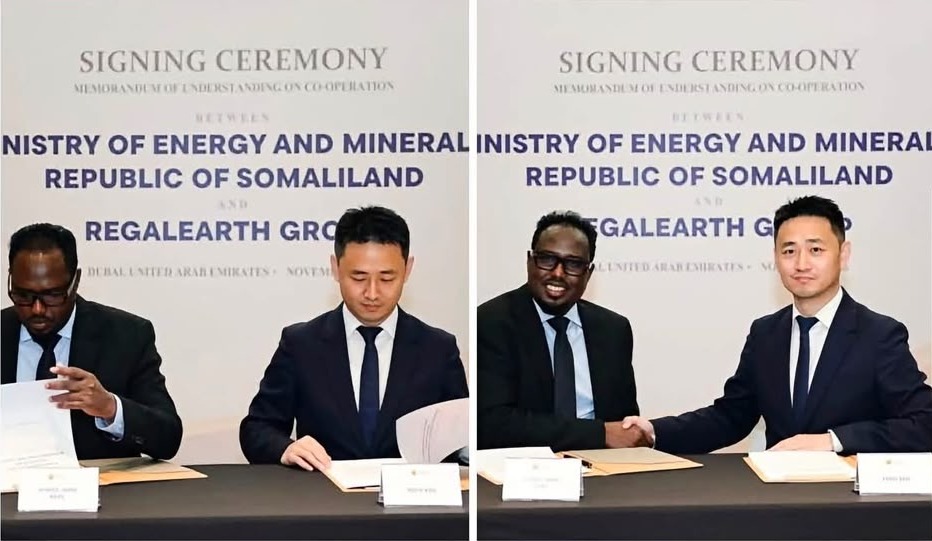
HARGEISA — Somaliland’s government has signed a memorandum of understanding with a company called RegalEarth to explore the country’s mineral resources. But a closer examination of the corporate network behind the agreement raises questions that the government has yet to answer: Who owns the company? Where is its investment capital? What mining projects has it completed? And why has the government not published the agreement or demonstrated that the investor passed basic due diligence?
The agreement was announced on 21 November following three days of meetings in Dubai between a delegation led by Somaliland’s minister of energy and minerals and representatives of RegalEarth. The signing took place at the JW Marriott Hotel. The government described the document as a memorandum of understanding, or communiqué, intended to establish cooperation on mineral exploration and future development.
Yet the announcement offered almost none of the information that citizens would need to assess the significance of the transaction. It did not identify the minerals concerned, the geographical areas covered, the proposed investment, the company’s financial commitments or the timetable for exploration. Nor did it publish the agreement’s text or explain the legal identity of the company that signed it.
The lack of disclosure is particularly troubling because the available corporate records suggest that RegalEarth’s investment structure is considerably less established than its international presentation implies.
A corporate network without transparent ownership
RegalEarth presents itself as a Dubai-based mining investment group. Its corporate and recruitment materials identify Morgan Vantage Group, a Singapore-headquartered company, as its dedicated management company, responsible for strategic direction, corporate governance and operational management.
The distinction matters. A company that negotiates access to mineral resources is not necessarily the company that owns the capital, employs technical specialists or bears the financial risks of exploration.
Morgan Vantage’s own recruitment advertisements describe a network spanning Singapore, Dubai and Hong Kong. They also identify Regal Earth Capital (DIFC) as the employment-contract entity for certain positions. But the available advertisements do not disclose its DIFC registration number, shareholders, directors, authorised activities or regulatory status.
A Hong Kong company bearing the name RegalEarth Group Limited was incorporated on 16 September 2026, according to company-registration data published through a commercial directory drawing on Hong Kong government open data. Its registration number is 81239832. The company is listed as a private company limited by shares, with a registered address at Room 510, Wayson Commercial Building, Sheung Wan.
That incorporation date is significant. The company was established only about two months before the Somaliland agreement was announced. It does not establish that the company is fraudulent, or that it is necessarily the legal counterparty to the agreement. But it makes the question of corporate history unavoidable: Which entity actually negotiated and signed the agreement, and what assets or operational experience did it bring?
The Singapore connection raises further questions. Morgan Vantage Group Pte. Ltd., registered under UEN 202139656K, was incorporated on 15 November 2021. Singapore corporate-data aggregator The Grid identifies its principal registered business activity as information technology and computer services. It reports ordinary share capital of $10,000 and revenue below $1 million. Those financial figures are third-party data and have not been independently verified through audited accounts.
A company can legitimately expand into new sectors, raise external capital or manage investments on behalf of third parties. But a business claiming to manage a mining investment group should be able to demonstrate the financial resources, investment mandates and technical partnerships supporting that claim.
No publicly disclosed audited accounts, completed mining investments, exploration concessions or independently verified capital commitments have yet been identified for the RegalEarth structure.
The unanswered question of the money
Mining exploration is expensive. Geological surveys, geochemical analysis, drilling, environmental assessments, engineering and site infrastructure require substantial financing long before a commercially viable deposit can be established.
RegalEarth’s public-facing materials refer to access to family offices, institutional investors and strategic partners. But access to potential investors is not equivalent to committed investment capital.
There is no publicly disclosed evidence establishing how much money RegalEarth has available, which investors have committed funds, whether it has secured project financing or whether any financial institution has agreed to support its Somaliland operations.
Nor has the government disclosed a bank guarantee, proof of funds or independently audited financial statements demonstrating the company’s capacity to fulfil its proposed obligations.
The identity of Regal Earth Capital (DIFC) is particularly important. Its registration, ownership and authorised business activities could help establish whether the group has a genuine investment platform or is relying on a collection of affiliated corporate identities to project the appearance of a larger international organisation.
The Ministry of Energy and Minerals should publish the company’s registration certificate, ownership structure, financial statements and evidence of committed funding. Without these documents, the public cannot distinguish between a capital-backed mining investor and a corporate intermediary seeking to secure access to mineral resources before identifying the money and technical partners needed to develop them.
A history the government should not ignore
The RegalEarth agreement comes against a troubling historical record of Somaliland authorities entering into agreements with foreign companies whose credentials, financial capacity or legal identities were subsequently questioned.
In August 2018, the Ministry of Investment signed a billion-dollar memorandum with an entity presented as Maxtor Bank, described as a major Chinese financial institution. An investigation by Somaliland Chronicle reported that it could not find the institution in the relevant Chinese banking and securities registers. The publication also raised questions about the identities and corporate registrations associated with the people presenting the investment proposal.
The ministry publicly defended the agreement. The episode nevertheless exposed a fundamental weakness: the government appeared more interested in announcing an enormous investment than demonstrating that it had independently verified the institution claiming to provide it.
A few months later, another agreement raised similar questions.
In October 2018, the Ministry of Investment signed an agreement with Salternas for a proposed solar salt production project near Berbera. The company claimed to have secured a renewable 25-year lease covering 150 square kilometres of oceanfront land and projected revenues of $9.6 billion over 21 years.
A subsequent investigation by Somaliland Chronicle found that the company’s Australian entities had little visible business activity and that its German subsidiary, Salternas GmbH, reported share capital of just €25,000. The publication also reported that the proposed initial fundraising had not been secured.
The former minister of commerce, Mohamed Abdillahi Omer, denied signing the agreement or granting a concession, contradicting the account attributed to the Ministry of Investment.
The case illustrated something more serious than a poorly assessed investment proposal: even the government appeared unable to provide a consistent account of who had authorised the transaction and what rights had been granted.
In December 2019, the Ministry of Energy and Mineral Development announced an agreement with Anglo Somaliland Minerals Ltd, a British company incorporated in June of that year. Somaliland Chronicle reported that the company was less than six months old when the agreement was signed and found no evidence of substantial previous mining activity.
These cases do not establish that RegalEarth is fraudulent. They do, however, demonstrate why the government’s due-diligence procedures deserve scrutiny. Somaliland has repeatedly been presented with promises of extraordinary foreign investment without consistently publishing evidence that the counterparties possessed the financial and technical capacity to deliver.
The law is not an excuse for secrecy
Somaliland has since developed a more formal regulatory framework. The National Public Procurement Law, No. 82/2018, established principles of transparency and competition, although the World Bank subsequently noted that the institutions envisaged under the law were not yet fully operational at the time of its assessment.
The mining framework also sets out requirements that should make it possible to distinguish serious investors from speculative intermediaries.
The Ministry of Energy and Minerals’ published exploration-licence requirements state that applicants must demonstrate technical and financial capacity. They include certified ownership documentation, identification of shareholders holding more than 10 per cent, a bank statement showing a minimum of $80,000 for foreign applicants, geological reports, a work programme and an environmental protection plan.
The publicly available Somaliland Mining Act text also provides for a register of mineral rights and establishes conditions for special mineral concessions. Article 34 addresses investment thresholds, Cabinet approval and minimum expenditure obligations.
These provisions make the absence of public information about RegalEarth even more difficult to justify.
The government must clarify whether the November agreement is merely an initial cooperation document or whether it creates contractual rights relating to exploration, land access or future mineral concessions. It must also establish whether any separate exploration licence has been issued and whether the statutory requirements have been satisfied.
An MoU does not automatically confer mining rights. But that distinction makes publication of the document more important, not less.
The government owes the public answers
The Ministry of Energy and Minerals should disclose the complete signed agreement, identify the precise legal entity that signed it, publish the names of its directors and ultimate beneficial owners, and explain what financial and technical assessments were conducted before the government entered into the arrangement.
It should also disclose whether the company has completed any mining projects elsewhere, whether it owns exploration assets, who its financing partners are and what minimum investment obligations it has accepted.
The government should explain whether the selection process involved competing proposals or direct negotiations, who authorised the agreement and whether Cabinet approval was required.
There is also a broader question of political accountability. Somaliland’s natural resources are public assets. Decisions that may shape access to mineral deposits for years cannot reasonably be treated as private diplomatic achievements between ministers and foreign business representatives.
In July 2026, the Ministry of Energy and Minerals publicly rejected claims that Eastman Minerals had been authorised to undertake mining activities, saying the company was not registered with the ministry and had received no mineral rights. The ministry said the matter was under investigation. That episode demonstrated how easily claims about access to Somaliland’s mineral wealth can circulate without corresponding government authorisation.
The RegalEarth agreement now requires the same level of scrutiny.
Somaliland’s government has spent years arguing that it is capable of managing its own institutions, negotiating international partnerships and protecting its economic interests. Those claims carry little weight if its officials cannot establish who is receiving access to the country’s most valuable natural resources.
The central issue is not whether RegalEarth has a registered company, a website or an international network of business associates. It is whether the company can demonstrate that it has the ownership, money, technical expertise and operational record required to undertake the work it is proposing.
Until the government publishes that evidence, the agreement will remain defined less by the investment it promises than by the questions it leaves unanswered.
For a country whose leaders repeatedly invoke transparency, sovereignty and economic self-determination, the failure to explain who is being entrusted with its mineral wealth would represent a particularly damaging contradiction.