
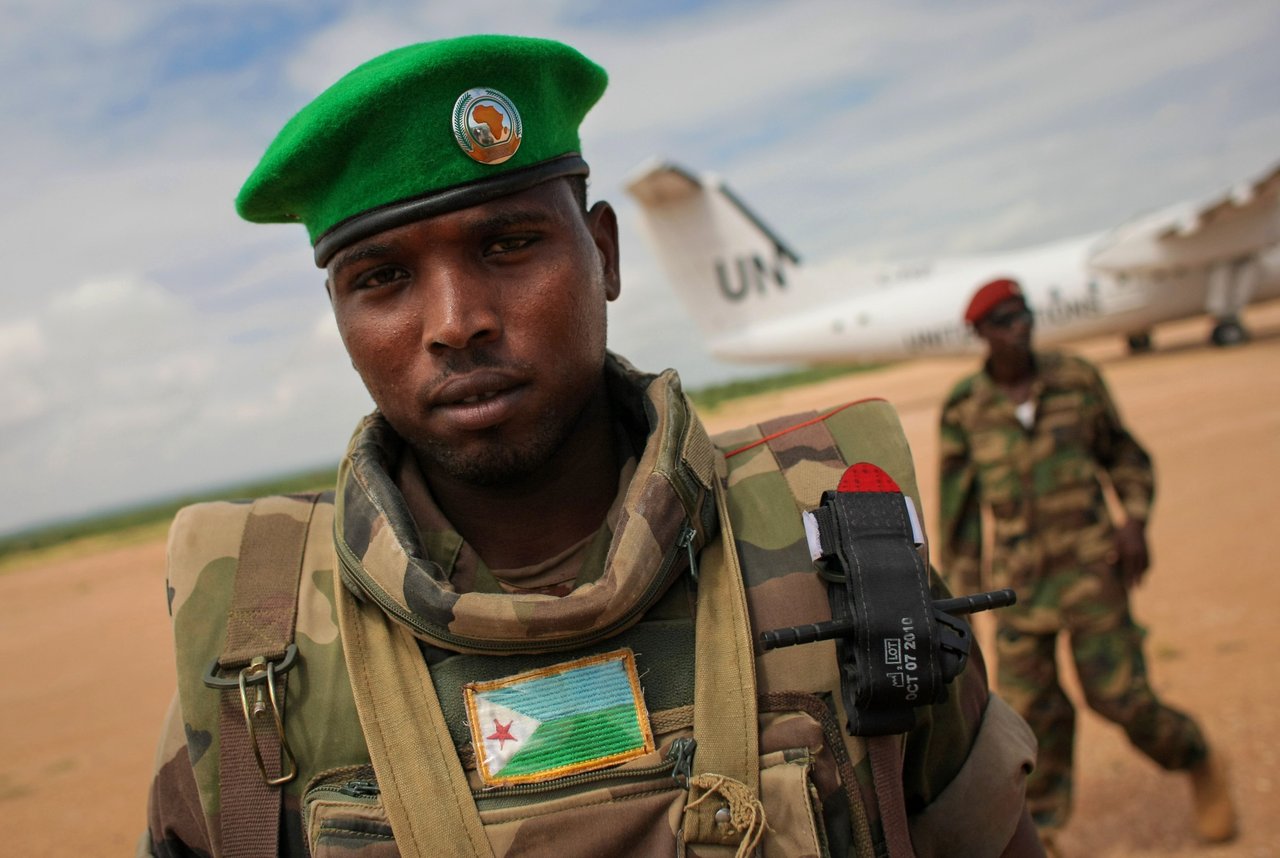
A clash between local militia fighters and Djiboutian peacekeepers shut the airport in Beledweyne, a central Somali city, and kept it closed for two days. By Monday morning, federal lawmakers and African Union commanders had agreed to open it again, on terms meant to stop another confrontation over troop flights into the town.
The fighting took place on 19 November at Ugaas Khalif Airport, in Somalia’s Hiiraan region. According to Hiiraan Online, militia fighters moved on the airport after receiving information that a military aircraft carrying additional federal government troops was on its way from Mogadishu. The aircraft turned back without landing once tensions rose on the ground.
Successive reports in the same outlet identified the local force as the Dulmi Diid militia and, later, as Macawisley fighters. At least one fighter was killed and six others were wounded in a brief exchange of fire with the Djiboutian contingent of the African Union Support and Stabilization Mission in Somalia, known as AUSSOM, according to local reports cited by Hiiraan Online. It was not immediately clear whether the peacekeepers had taken casualties.
That point was addressed the following day. In a statement issued on 20 November, the Djiboutian embassy in Mogadishu said its troops had repelled an attack by armed fighters and had prevented the airport from being seized. The embassy also said that no Djiboutian personnel were killed or wounded.
The Hirshabelle administration then directed Djiboutian peacekeepers and Somali security forces to prevent armed individuals from entering the airport. The directive, as reported, did not explain how it would be enforced or whether exemptions would apply to those responsible for airport security. After discussions with military commanders and airport officials, the militia fighters withdrew. Djiboutian forces remained in control of security at the facility.
The airport itself paid a price. Adan Muhumed Ali, the airport manager, told Hiiraan Online that Ugaas Khalif would stay closed on Saturday and Sunday, 21 and 22 November, so that the runway and other damaged areas could be repaired. Traditional elders and security officials were expected to meet in the interval. Hawadle traditional leader Ugaas Yusuf Ugaas Hassan was due to talk with airport administrators and Djiboutian military officials about the confrontation, outstanding security concerns and future cooperation.
The reopening was settled on Sunday, 22 November, at the headquarters of AUSSOM’s Sector Four. Federal lawmakers Abdirisaaq Abdullahi Ma’alin, Abdinasir Haji Shirwac and Mohamed Abdullahi Burale met the sector’s deputy commander, Colonel Wundimo Memomssa, the Djiboutian contingent commander, Colonel Ahmed Adan, and other African Union officers. They agreed to reopen the airport on Monday, 23 November, to withdraw troops stationed outside the airport premises, and to prohibit the landing of aircraft carrying military personnel or additional troops.
Those terms were designed, the report said, to prevent further confrontations over troop movements into Beledweyne. The two sides also agreed to hold further discussions specifically about the deaths and injuries. Responsibility for the casualties had not been settled.
The airport dispute did not arise in a vacuum. It comes after the 24 October re-election of Hirshabelle President Ali Abdullahi Hussein Gudlawe and the election of Abdifatah Hassan Afrah as vice president. Some traditional elders, politicians and militia groups in Hiiraan have rejected that process, accusing the regional administration of failing to address long-standing grievances over political representation and power-sharing. Ugaas Yusuf has called for broader consultations among Hiiraan communities about the region’s political future.
Beledweyne is the main town of Hiiraan and a gateway between Mogadishu and Somalia’s centre. Ugaas Khalif Airport is a key transport link for the town and the surrounding communities. When it closes, even for two days, passengers, aid flights and local commerce feel the interruption well beyond the runway. When the reason for the closure is a firefight between a local militia and foreign peacekeepers over a federal troop flight, the episode also becomes a test of who controls access to the region.
What can be said with confidence is limited, and it is enough. There was an armed confrontation at the airport on 19 November. A planned flight from Mogadishu did not land. The airport was damaged and shut. Djibouti’s embassy says its soldiers were not harmed and that they stopped the facility from being taken. Local reports say one militiaman was killed and six were hurt. Lawmakers and AUSSOM officers have now agreed to reopen the airport and to keep further military aircraft from landing there, while talks on the casualties continue.
Hiiraan Online, filing from Beledweyne, has provided the most detailed public account of both the clash and the reopening terms.
The political argument in Hiiraan is not resolved. The security arrangement at the airport is a truce, not a settlement. But the immediate crisis, the closure of a civilian airfield after a clash with African Union troops, has at least been pulled back from the brink.