
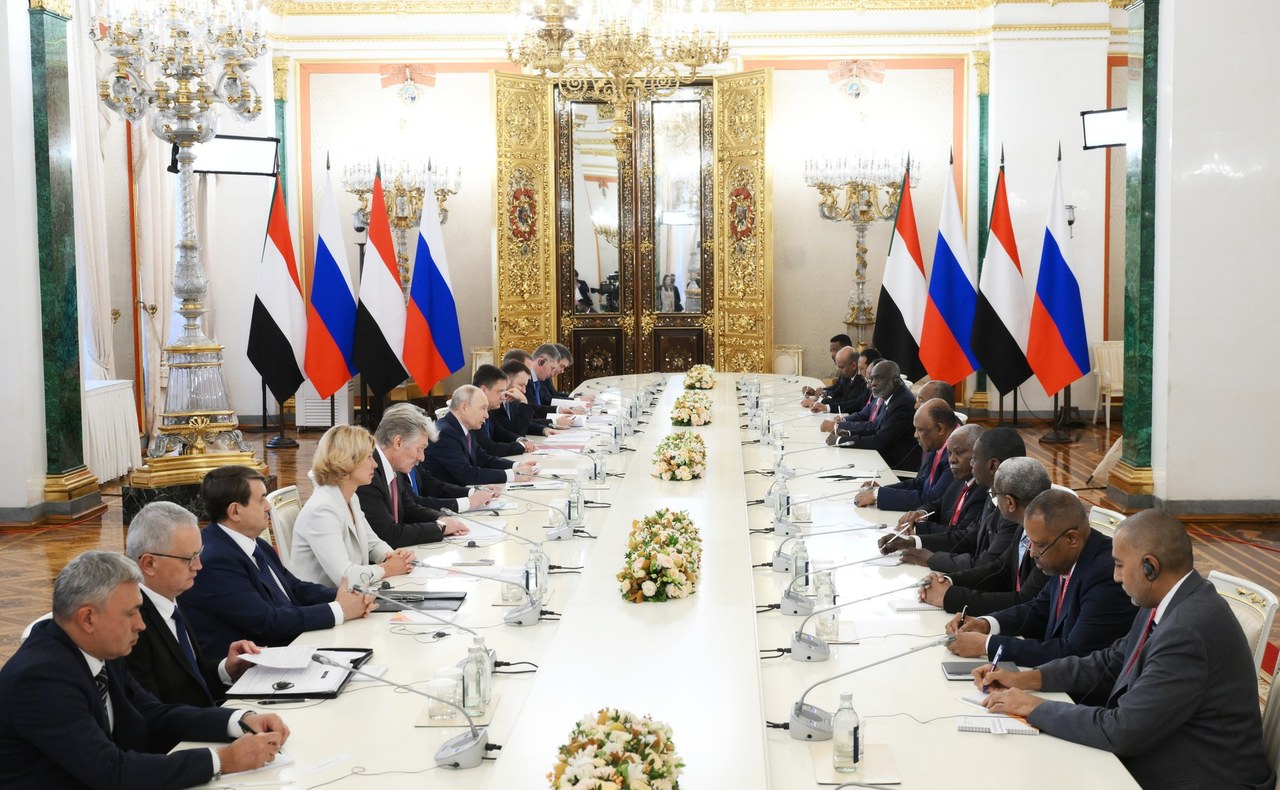
Sudan’s army chief, Abdel Fattah al-Burhan, used a visit to Moscow to put gold, copper and a slice of the Red Sea on the table for Russia. What he did not do, in any public announcement, was confirm a naval base.
The talks took place on 30 October 2026, after the third Russia–Africa Summit. The Sudan Times, citing Russia’s TASS news agency, reported that Burhan offered Moscow access to gold, copper and other mineral deposits, together with a proposal to establish a Russian free economic zone on Sudan’s Red Sea coast. Burhan, the report said, told his hosts that Russian companies could develop mining operations across Sudan and set up fuel and wheat storage facilities inside the proposed zone.
He also invited Russian investment in Sudan’s railway network. “Logistical chains for transporting goods via railways can be established with the participation of Russian companies,” he said, according to the same account.
The offers were presented as part of an effort by the Port Sudan authorities to widen economic and strategic ties with Moscow as Sudan’s civil war enters its fourth year. Neither side, The Sudan Times reported, announced a timetable for the mining projects or for the free zone, and details of any investment commitments were not immediately disclosed.
President Vladimir Putin, according to the same report, said Moscow was willing to expand cooperation with Sudan in digital technology, healthcare, education, logistics and industrial development, and that Russia had prepared a roadmap of priority areas. Russian state broadcaster RT was cited as reporting Putin’s claim that trade between the two countries had increased by 25 per cent in the first eight months of 2026 compared with the same period a year earlier, and that Sudan was among Russia’s ten leading trading partners in Africa.
Putin also said Russia was exploring ways to contribute to efforts to end Sudan’s war, calling for a halt to hostilities and a negotiated political settlement. Burhan, who arrived in Moscow on 29 October to head Sudan’s delegation, restated his opposition to external interference in the country’s political future. Addressing the summit, he said any peace settlement must be driven by Sudanese actors. He also said the Port Sudan authorities were working towards a civilian democratic transition through an internal political dialogue, followed by a transitional period and elections monitored by regional and international observers.
Those are the elements that can be tied to named official remarks and to TASS, as relayed by The Sudan Times: minerals, a Red Sea free zone with storage for wheat and fuel, railways, a cooperation roadmap, and a public disagreement over how peace should be made.
A more sensitive claim sits beside them. On 3 November, Sudan Tribune reported that closed-door talks between Sudanese and Russian officials had “reopened discussions on establishing a Russian logistics support point and naval base on the Red Sea coast.” It attributed that account to “informed sources,” not to a public statement by either government. The same article said the free-zone proposal served, in those sources’ description, as a civilian and logistical compromise: a way to ease regional and international concern over a Russian military base while still giving Moscow a foothold on the coast.
Sudan Tribune itself noted that both countries have periodically denied new developments regarding a naval base in Port Sudan, and that current talk has been linked to a 2020 agreement still pending parliamentary ratification. The potential base, it said, has raised concern in the United States, European states, Egypt and Saudi Arabia because of its implications for Red Sea shipping. It also recalled a Wall Street Journal report, from the previous year, that Sudanese military authorities had offered Russia its first naval base in Africa.
Those naval-base claims have not been confirmed by an official announcement from the authorities in Port Sudan or from the Kremlin in connection with the October meeting. They should be read as unverified. What was openly described is a free economic zone and a package of mining and logistics proposals.
Sudan Tribune also reported that a high-level Sudanese delegation, including intelligence and defence-industry officials, sought advanced Russian military supplies, including drones and air-defence systems, and that, in exchange, Sudan offered extensive concessions in gold, copper and other mineral mining. The delegation, it said, urged Russia to take a stronger stance in support of the Sudanese army’s international legitimacy and praised Moscow’s backing at the United Nations Security Council. That account, too, goes beyond the TASS-sourced public offers and should be treated as reporting, not as a signed bargain.
The strategic logic is not hard to see. Sudan has gold and other minerals, and a coastline on one of the world’s busiest shipping lanes. Russia has spent years seeking closer political, military and economic ties in the Horn of Africa and a durable position on the Red Sea. Burhan’s government in Port Sudan is fighting a war that began in April 2023. An economic opening to Moscow is also, in that setting, a search for a powerful partner.
Whether the mining offers, the free zone and the railway invitation become contracts is another question. No timeline was announced in Moscow. The naval-base file, if it has been reopened at all, remains in the realm of unnamed sources and an unratified 2020 text. What can be reported, on the record, is simpler and still striking: in a formal meeting with Putin, Burhan put Sudan’s gold, its copper and a stretch of the Red Sea in front of Russia, and asked Moscow to come in.