
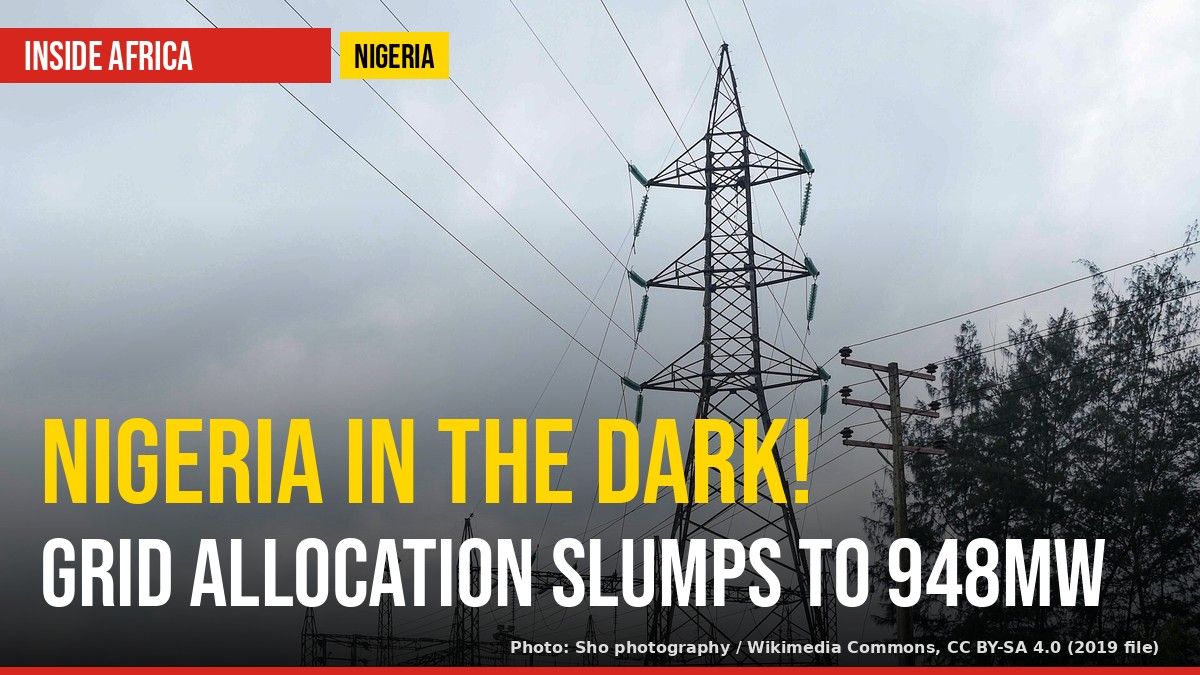
ABUJA — For a few hours on Friday, the electricity shared out to Nigeria's estimated 220 million people fell below 1,000 megawatts, about what a single large power station can produce in many countries.
Data on the Nigeria Grid website showed that the 11 electricity distribution companies (DisCos) received a combined allocation of just 948 megawatts (MW) on Friday afternoon, 20 November, Peoples Gazette and Newsdesk Africa reported.
The news spread fast. Peoples Gazette's post on X drew more than 1,500 likes and 1,000 reposts, Instablog9ja's post was viewed almost 140,000 times, and a widely shared joke about life without power drew more than 15,000 likes as Nigerians vented about another day of outages.
The figure is an allocation to the DisCos at a particular moment, not a measure of all the electricity generated in Nigeria that day. But it shows how little power was available to homes and businesses when the disruption hit.
Who got what
According to the grid data reported by Peoples Gazette, Ikeja DisCo received the largest allocation, 133MW, followed by Eko with 132MW and Ibadan with 119MW. Benin received 115MW, Enugu 110MW, Abuja 109MW and Port Harcourt 104MW.
The northern DisCos received far less: Yola 37MW, Kano 31MW, Jos 30MW and Kaduna just 28MW.
To put that in context, the Lagos companies of Ikeja and Eko together received 265MW to serve one of Africa's biggest cities.
What went wrong
The Nigerian Independent System Operator (NISO), which runs the grid, blamed the disruption on the tripping of four transmission lines, Nairametrics and Newsdesk Africa reported.
According to NISO, the Omotosho-Ikeja West line tripped first, at 14:34 UTC+3, causing a significant drop in load within the Lagos area. Sixteen minutes later, three more lines tripped: Ihovbor-Osogbo, Benin-Egbin and Ihovbor-Ajaokuta. That caused load losses in several parts of the country.
NISO insisted it was not a nationwide collapse. "The grid disturbance experienced earlier today was not a system collapse, but a result from the tripping of some transmission lines, which caused load losses in parts of the country," the operator said in a statement.
It said emergency teams worked with the Transmission Company of Nigeria (TCN) to stabilise the grid, and all four lines were restored by 16:49 UTC+3. NISO urged the public to rely on its official communications for accurate information.
A partial rebound
Allocations recovered later in the day. Newsdesk Africa reported that the total rose to 2,717MW by 19:25 UTC+3 and to 3,046MW by 22:20 UTC+3, with Abuja DisCo receiving the largest share, 597MW.
But Newsdesk Africa said the recovery "has yet to translate into actual power supply for many end-users, as several communities across the country remain in darkness".
Even 3,000MW is a small amount for a country of Nigeria's size. South Africa, with less than a third of Nigeria's population, routinely produces many times more electricity.
A deeper crisis
Friday's disturbance came amid wider worries about falling generation. Peoples Gazette described "a worsening electricity crisis", and recalled that the national grid collapsed twice in four days in January, when generation crashed from 3,825MW to almost nothing within minutes.
Earlier this month, on 5 November, NISO blamed falling generation on gas supply problems at thermal power plants and lower water levels at hydroelectric dams, Nairametrics reported. That had meant shorter supply hours and more load shedding.
The national oil company NNPC disputed the gas explanation a day later, saying its gas production had grown by about 10% this year and its pipelines had no transport problems affecting power stations. It called for a joint review including gas suppliers, power generators and NISO.
The blame game extends further down the chain. Nairametrics reported that TCN recently accused Ikeja Electric of misleading customers by blaming feeder outages on grid instability. TCN said 68% of the interruptions on Ikeja Electric's feeders on 1 and 2 November were caused by low generation, while 26% were linked to the DisCo's own faults, maintenance or failure to follow load allocations.
Why it matters
Electricity is the issue that touches every Nigerian. Without reliable power, households and businesses rely on petrol and diesel generators, which are expensive, noisy and polluting. Fuel prices have soared since petrol subsidies were removed, making the cost of running a generator a heavy burden for families and small businesses.
Power shortages also hurt jobs and investment. Manufacturers, hospitals, banks and telecom companies all spend heavily on backup power, costs that are passed on to consumers.
What comes next
NISO says the grid has been stabilised, but the underlying problems remain: limited gas supply, weak transmission lines and disputes over who is responsible. Until those are fixed, Nigerians fear more days like Friday.