
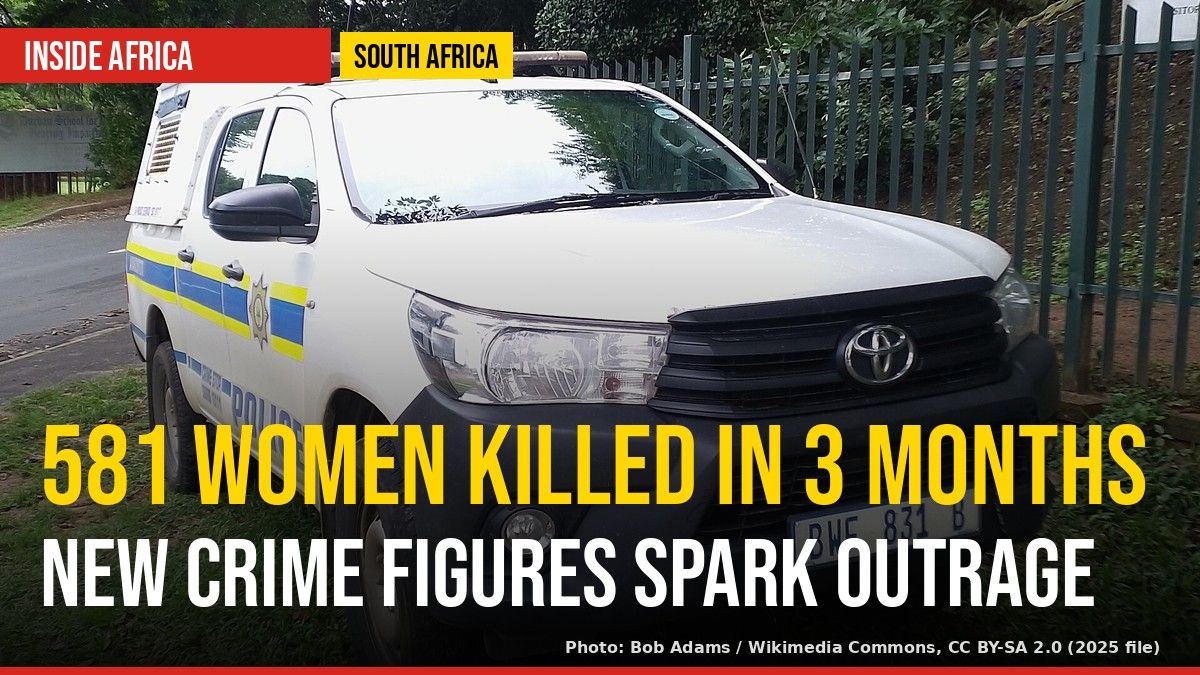
PRETORIA — South Africa recorded 581 murders of women in just three months, according to the latest crime statistics, a figure that has reignited anger over gender-based violence across the country.
The quarterly figures, released in Pretoria on Friday, 20 November, by Acting Police Minister Firoz Cachalia, showed that 5,590 people were murdered between July and September 2026. That is 204 fewer than the 5,794 recorded in the same period last year, a fall of 3.5%, but it still means about 60 people were killed every day.
The BBC's post on the figures became one of the most-viewed African news posts on X this week, with almost 1.4 million views and thousands of reposts.
The victims
Police could verify the age and sex of 5,549 murder victims. Of those, 4,819 were adult men, 581 were adult women and 149 were children, according to the police figures reported by TimesLIVE and AFP. Police could not determine the age and sex of the other 41 victims.
The BBC reported that 131 of the women were killed in Gauteng, the province that includes Johannesburg.
It is not clear whether the number of women killed has risen or fallen. The BBC reported that police had recently stopped publishing those figures because of what they said were "significant anomalies" in the statistics.
A terrible year for women
The figures include 13 women whose bodies were found dumped in public areas in and around Johannesburg, a series of killings that caused national outrage, the BBC reported.
On Thursday, Gauteng police chief General Tommy Mthombeni said eight people had been arrested in connection with those murders. Three of the arrests relate to the killing of Elizabeth Moselakgomo, a 38-year-old runner who disappeared during her daily run near her home in Kempton Park. Her body was found on 12 September.
The violence continues. The BBC reported that five women and a toddler were shot dead in Botshabelo in the Free State this week, when three masked men forced their way into a house. No arrests have been made.
In September, President Cyril Ramaphosa vowed that "no stone will be left unturned" to find those behind the Gauteng killings and announced new measures against gender-based violence.
Rape and children
The rape figures are among the most disturbing. Police recorded 9,908 rapes in the quarter, TimesLIVE reported. Of the 9,705 cases in which the victim's age and sex could be verified, 4,362 victims were children under 18, 5,116 were adult women and 227 were adult men.
"Victims cannot be expected to carry the burden of a system that should serve them," Cachalia said.
National police commissioner General Fannie Masemola said more than 10,000 people were arrested for gender-based violence and femicide during the period, and 668 were sentenced to prison, 88 of them to life.
Ten murders and 103 rapes took place on educational premises, including 50 rapes at schools, police said.
"Far too high"
Cachalia welcomed the continuing fall in murders but warned there was little to celebrate. "Violent crime, despite this downward trend, remains far too high," he said, according to TimesLIVE. "The figures for violent crime in our country are still high. We can say the murder rate is coming down... but the numbers are still high," he told reporters, AFP reported.
Some crimes fell sharply. Carjackings dropped by 16.8%, truck hijackings by 27.9% and house robberies by 7%. Cachalia said this marked a change after 13 years in which most violent crime categories had been rising.
Others rose. Attempted murders went up by 3%, kidnappings by 3.4% and cash-in-transit robberies from 24 to 36 cases.
Guns, alcohol and arguments
The most common cause of murder was an argument or fight, which led to 955 killings. Firearms were used in 2,552 murders, more than any other weapon. "A firearm turns a dispute into a death," Cachalia said.
Alcohol was another driver, with 8,201 alcohol-related contact crimes, including 271 murders. Another 235 murders happened in or around taverns and shebeens. Police said they shut down 6,495 illegal liquor outlets and seized 3,799 illegal firearms in the quarter.
Gauteng had the most murders, with 1,418, while the Eastern Cape had the highest risk of being murdered, followed by the Western Cape and KwaZulu-Natal.
Why it matters
South Africa has one of the world's highest murder rates, and violence against women has been called a national crisis. A falling murder rate is welcome, but for families the numbers mean little while women are still being killed at a rate of more than six a day.
The statistics also arrive after a brutal week. AFP reported that 17 people were killed in two mass shootings, one in an informal settlement outside Pretoria and one near Pietermaritzburg.
What comes next
Activists are expected to use the figures to push for faster prosecutions and better protection for women and children. The 16 Days of Activism against gender-based violence, marked every year from 25 November, begins next week.
Sources
- BBC: Nearly 600 women killed in South Africa within three months
- TimesLIVE: Murders fall by 3.5%, but 60 people are still killed every day
- Africanews/AFP: South Africa's murder rate falls but killings average 60 a day
- South African Government: Release of the second quarter crime statistics
- BBC World on X